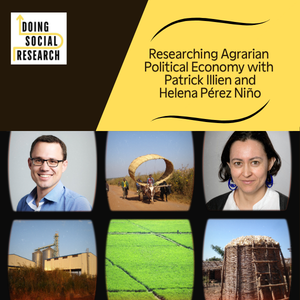

SHOW NOTES
What happens when the categories we use to understand the world don’t quite capture the messy realities of people’s lives? And what if the most important things we need to understand aren’t just who people are or what they have, but how social hierarchies, power and intersectional factors interact?
In this fascinating episode, political economists Dr. Patrick Illien and Dr. Helena Pérez Niño join Professor Phyllis Rippey to discuss their new article, “From Theory to the Field and Back Again: Fieldwork-Based Research on Social Differentiation in Agrarian Studies,” and the methodological challenges of researching agrarian change. Drawing on their review of fieldwork-based studies, they explore how researchers translate theoretical concepts into practical research questions and what gets missed when we sort people into seemingly fixed socioeconomic categories instead of examining the relationships of labour, production, property, and power that shape their lives.
But what exactly is agrarian political economy? What is a unit of analysis (and why should we care?!?), what is methodology? and how do we move from theory to the field and back again without losing sight of the social relations we’re actually trying to understand? Helena and Patrick takes us from tobacco gendered inequalities in farming in Mozambique, where changes in agricultural production complicated land ownership and marital relations, to conversations on the relationship between farming and menopause, marriage, global agricultural markets, and research methodology all in one conversation!
Together, Patrick and Helena invite us to rethink how we do social research, challenging us to look beyond static classifications and pay closer attention to the relationships, inequalities, and transformations that make social life so wonderfully complicated. Listen in for a conversation about power, gender, agriculture, and the sometimes-tricky business of making our research methods live up to our theories and methodological design!
GUEST BIOS
Dr. Patrick Illien
Dr. Patrick Illien is a political economist affiliated with the Centre for Development and Environment at the University of Bern and the Food Systems Economics and Policy Group at ETH Zurich, Switzerland. His research examines agrarian change, labour relations, economic development, and the social and economic transformations associated with agricultural intensification.
Drawing on mixed-methods fieldwork, Dr. Illien has investigated rural labour markets, agricultural production, and social differentiation in Laos and Rwanda, examining how changing economic structures shape livelihoods, gender relations, and inequalities in agricultural communities. His publications include Coffee and the Agrarian Questions in Laos and Rwanda: Taking a Bottom-Up Perspective, published in the Journal of Rural Studies (2024), and research on political settlements and structural change in developing economies. Dr. Illien holds a PhD in Geography and Sustainable Development from the University of Bern.
Dr. Helena Pérez Niño
Dr. Helena Pérez Niño is an Assistant Professor at the International Institute of Social Studies (ISS) at Erasmus University Rotterdam. Her research focuses on the political economy of development, particularly agrarian change, gendered labour relations, the social organization of agricultural production, and the consequences of integration into global agricultural markets. Her doctoral research at SOAS University of London explored agrarian gendered transformations in farming, in Mozambique.
Dr. Pérez Niño serves on the editorial board of the Journal of Agrarian Change and co-founded the Contract Farming Initiative research network. Her scholarship contributes to critical debates on agricultural development, rural livelihoods, and the gendered dimensions of agrarian transformation.
Together, Dr. Illien and Dr. Pérez Niño authored From Theory to the Field and Back Again: Fieldwork-Based Research on Social Differentiation in Agrarian Studies, published in the Journal of Agrarian Change (2026). Patrick Illien and Helena Pérez Niño reviewed 83 fieldwork-based journal articles in their 2026 study, to make social differentiation and the relationships that shape agrarian inequalities visible.
OTHER CITATIONS & PLACES MENTIONED
Food systems Economics and Policy
EPISODE TRANSCRIPT
Automatic transcript with speaker labels and approximate timestamps. [Unclear] marks unresolved wording; [Speaker uncertain] marks an unresolved voice.
[00:00:01] Phyllis Rippey
Hello and welcome to the Doing Social Research podcast, where I talk with people who do social research to dig into the cool projects they’re working on, along with the struggles and successes that they’ve had in their careers. My goal is to demystify research for students, inspire other researchers, and provide a platform for the brilliant work being done in the humanities and social sciences. I’m your host, Phyllis Rippey, a professor of sociology at the University of Ottawa and creator of doingsocialresearch.com. But today, we’re not here to talk about me. We are here to talk with political economist Patrick Illien and Helena Pérez Niño about their new article from theory to the field and back again, field work-based research on social differentiation in agrarian studies published in the journal of agrarian change and about the field of agrarian studies in general and methodological challenges they pose to how we can think relationally when doing research rather than just seeing people as stuck into static categories.
[00:00:56] Phyllis Rippey
I’m super interested to learn more and to… dig into this idea because I have lots of thoughts on it. But first, Patrick Illien is a political economist whose research focuses on agrarian change, labor relations, and economic development. His work has examined agricultural intensification, rural labor markets, and structural change in Laos and Rwanda and beyond. and he is affiliated with the Food Systems Economics and Policy Group at ETH Zurich. Helena Pérez Niño is an assistant professor at the International Institute of Social Studies at Erasmus University Rotterdam. Her research examines the political economy of development, especially the social organization of agricultural production and the effects of globalized agricultural markets. Her work has traced post-conflict agrarian reconstruction in the Mozambique Malawi borderland, contract farming, labor regimes, and the effects of agricultural intensification on gendered power relations. She also served on the editorial board of the Journal of Agrarian Change, co-founded the Contract Farming Initiative Research Network, and is one of the editors of the journal Development and Change.
[00:01:55] Phyllis Rippey
Together, Patrick and Helena have previously studied agrarian class relations in Rwanda through a labor-centered approach. Their new article reviews 83 fieldwork based studies to make visible something researchers often leave hidden, the practical and analytical work of moving from theory to research design to the field and back again. And also within how do we think about the unit of analysis, which I often talk to my students about, and a lot of people don’t know what that is, which we’ll talk about. But first, Patrick and Helena, welcome to the doing social research podcast. How are you both doing?
[00:02:27] Helena Pérez Niño
Thank you. Hello, Phyllis.
[00:02:31] Patrick Illien
Hi, Phyllis. Thank you for having us.
[00:02:34] [Speaker uncertain]
It’s a pleasure.
[00:02:35] Phyllis Rippey
Well, I always like to start with my titular question. What research are you doing? Social research are you doing these days?
[00:02:47] Helena Pérez Niño
Patrick, should I go first?
[00:02:49] Patrick Illien
Yeah, yeah, go ahead.
[00:02:51] Helena Pérez Niño
Well, Patrick and I have been collaborating now for a long while. But something that we have in common, as you mentioned before, is that we’re both researchers in political economy and very specifically agrarian political economy, which is nested under the broader umbrella of agrarian studies and looks at relations of production, power. property in agrarian settings, but it’s in this respect critical social sciences, so quite different from the more technical approaches to agronomy, agricultural economics. We are interested in the social transformation over time, power dynamics, in our case specifically in agrarian settings, or among communities and groups for whom agricultural production is central. And I, in particular, trained as a political economy, also in development studies, and have conducted work now in a range of settings. I think, perhaps in my case, the common thread running across my different projects has been a sustained interest for that intersection between intra-household relations, especially conjugality, and the participation in global supply chains.
[00:04:09] Helena Pérez Niño
Export agriculture. So I’ve looked for instance, and this was my doctoral research at SOAS University of London, at the way matrilineal region in Mozambique where land inheritance largely followed the side of the wives was transformed when this region adopted tobacco production for export because the companies that signed this production agreements did the negotiation with the husbands. So this turned sort of like the wives into the landladies to the husbands that became the farmers or the workers of this farm. And a lot of the tensions of this production became became interiorized into the conjugal relation. Quite interesting, and as you can imagine, a recipe for disaster in some cases. But more recently, I’ve been conducting work in the Philippines looking at cooperatives in the oil palm sector. And again, here, all these imbrications of kinship and employment and tensions, you know, express and manifest themselves in an array of quite fascinating transformations inside the household.
[00:05:34] Helena Pérez Niño
And I’m also now going through perimenopause. So I’m more interested in the way menopause transformed the lives of women working in the agro industry. So I’m tracing a group of women. that went through menopause while working in Colombia in the cut flower sector. It’s fascinating. I think we haven’t done research on this and I’m very excited about…
[00:06:01] Phyllis Rippey
That is so… Patrick, we’ll get to you in one minute.
[00:06:05] Patrick Illien
Yeah, yeah, please, please take your time.
[00:06:08] Phyllis Rippey
I find this so fascinating because… And I’m so excited to have found you or that you found me because, like, my research, a lot of my research is on… like breastfeeding politics and sort of the political economy of breastfeeding in a way that and lately I’ve been sort of and I’ve been looking at Indonesia in particular and I don’t want to make this all about my own research but I’ve been very much getting more into sort of international sort of post-colonial theorizing and Marxist theorizing and looking at the ways in which sort of breastfeeding becomes a tool of neo-imperialism like breastfeeding promotion, sort of getting away from this, like the focus is always on the Nestlé boycott. And I’m more interested in sort of how global political actors have instrumentalized breastfeeding as a way to sort of get a, make a claim on women’s bodies as a solution to like global poverty and things like that.
[00:07:07] Phyllis Rippey
And so I am, but I also just was at a conference about a month ago on the, on motherhood. And there was people talking about in, about breastfeeding in Burkina Faso and the fact that like 90% of work, like of employment, I think by women is in the informal sector. And so I’ve just. And because of that, and like 40% of that, something like that, is in agriculture. And so it suddenly just occurred to me a few weeks ago that like the embodied nature of women’s work in countries where you don’t just get to take a mat leave. You don’t just get to have like the entire idea of social policy suddenly no longer applies if you’re working in the field. And so this. I love what you were just talking about, besides the fact that I also am going through perimenopause, and it is like, why did nobody talk about this?
[00:08:10] Phyllis Rippey
Although, if they talked about it when I was younger, I would not have listened. I wouldn’t have been like, ah, that’s the future. But it is so real. And how, like, I just find it so interesting thinking about, like. I just like agriculture is like your field, agrarian studies is something that is very new to me. And this idea and so it had not occurred to me before because I am a Western white woman who is as narcissistic as the rest. And so this idea of like how do we address the embodied nature of being a human being in work contexts that are not amenable to are the changing. parts of our bodies, but also I think sometimes we can get into sort of feminist, quote unquote feminist debates, can sometimes get the sort of idealist view of like agrarian times also at that conference. And I’m going to shut up in a second because I could talk forever.
[00:09:06] Phyllis Rippey
At this conference there was this other woman there who was like, I don’t know, she wasn’t my cup of tea in terms of what she was talking about, but she kept saying like, oh, we need to get away from like industrialization and like go back to a time where like, you know, there wasn’t the like separation of like, you know, like private and public spaces or whatever. And I’m like, I don’t know. Like that seems like the romanticization of like agrarian life is also. no better than the romanticization of industrial capitalism. But I don’t know if you have anything to say to any of that. I’m just excited.
[00:09:42] Helena Pérez Niño
Regarding what you mentioned about this sort of like Eureka moment, and I think people going through perimenopause have when they realize this really transforms our lives. And we don’t have the tools because we didn’t even know it existed. We were just expecting menopause. And then as social researchers, when we go back to the things that we asked in the field and we never cared to us. I had spoken with so many people struggling for concentration, body aches, etc. But it never occurred to me that… This could have been a thing until it happened to me. And I think this by now, you know, it’s a part of the public debate and it’s now being debated. There’s fascinating podcast now being produced all over Latin America. You can follow them. But I think it’s slowly also coming to academia. And what do you say about this romanticization of industrial production or the romanticization of Peasant societies is very much the bread and butter of what Patrick do and have done.
[00:10:58] Helena Pérez Niño
And we have very set ideas, very strong ideas around this that we’ll be very happy to share through this podcast.
[00:11:07] Phyllis Rippey
Yeah. Well, maybe that’s a good transition into Patrick. I want to hear what your, if there’s like what your research are doing, but also if you want to speak to that a little bit, I would love to hear more.
[00:11:20] Patrick Illien
I’ll maybe start a little bit with the history of how we came even about talking to those issues because we were both trained at, as Helena mentioned, at SOAS University of London in kind of a materialist political economy that we tried to, I think, apply to this day. And so we’re very much framed by that. And it was funny because actually Helena was my seminar tutor when I did my master’s degree. And I’ve never quite experienced such engaged and sharp debates in a student seminar anytime before or after. So like her commitment and enthusiasm is really contagious to the students and and to me in particular. And so when we decided to join forces, you can imagine how psyched I was. And that, you know, be, okay, wow, there’s somebody who thinks along those lines, but what does this mean for fieldwork, you know? And so I’m starting out from this political economy and political kind of development that we both did, it’s very, it quickly became clear that the central.
[00:12:37] Patrick Illien
Questions in this field are about class, labor relations, production systems, and property. And by doing that, I think you look automatically at both productive and deconstructive forces that structural change in capitalism more broadly has brought. But when you work over the years in many… rural areas, of course, You also see and you talk to people and you ask them, you exchange views that they also say, like, you know, I do want my herbicides, my fertilizer, I do want my tractor, I also want to participate. So sometimes I think there is indeed a bit this notion of, oh, wouldn’t it be nice if it was all different? But having said that, of course, there is a very real question also of what is the role of agriculture and similar. approaches in producing a sustainable future because keeping going the way we have going clearly cannot cannot be an option but so yeah these these are actually a bit the questions also that’s that I have in in my head as I go about research and like you mentioned starting out in Laos and Rwanda working on the employment nexus between poverty and equality on the one hand on the ground and larger structural change and growth trajectories which both these countries have experienced in their post-conflict trajectory and more recently also looking at what you mentioned informality specifically I’m still in the food system but not in rural settings but in Ghana we have a photovoice project and where we work with In this case, it’s actually almost exclusively women who work as restaurant operators or wage workers.
[00:14:31] Patrick Illien
In these conditions that you mentioned, you know, social policy is of course organized very differently. access to a very limited extent, sometimes in the informal economy. And this question of the embodiment of labor, it’s interesting you mention that we’re not talking about this today, but I’m currently working on a paper, I’m talking exactly about this, this embodied labor of working in the heat, standing all day on your feet and what this does to their bodies. And the same, of course, goes in agriculture, which is very much a physical, physical work. And so in addition to that, we also look at participatory guarantee schemes in Vietnam, which is kind of a way to come away from third-party certification [unclear] in the Global North, but to develop more bottom-up driven certification schemes in the global south. But again, it’s not as simple as that nice story because there are again questions of land or of labor, of economies of scale.
[00:15:43] Patrick Illien
Can you even even do that productively? And so I think these these questions by specifically in our case to agriculture, but but but far beyond, and of course also in the global north. And I think one thing that interests me in that always was the question of methodology, not just methods, but of methodology of how can we, what are the practical challenges of applying specific methods in the field to inform a larger argument and put that in a conversation with theory and conceptual development and that those are a lot of questions I ask myself getting into this and asking Helena about because that it’s very hard sometimes to find a lot of a lot of books on that because it’s more like something done learning by doing and conversations and so on and also um Another thing that struck me that is the value of mixed methods, really conducting large-scale surveys, but also photovoice methods, life histories, to really also make this jump from the field to the theory and from the micro to the macro, which will come back later.
[00:16:55] Patrick Illien
So I’m very excited to also share our experience and hopefully engage the debate further.
[00:17:01] Phyllis Rippey
Yeah, no, this is incredible. You all have like just in… I don’t know, 15 minutes taking us on a trip around the world. This is, it’s unbelievable. I’m like, do you sleep? But I want to, let’s get into the. No, let’s get into the. Oh, my God, right? Oh, my God. Yeah, I sleep every two hours [unclear] and then cannot stay asleep. But this question of methodology versus method, which I think is such a, I actually have a post on the website about what is that difference. And I think students often have sort of trouble sort of identifying what that difference is, even though it’s kind of basic. But maybe could you like? explain, like, what do you see as the difference between method and methodology and sort of just tease out those ideas a little bit more about what you were just saying, about why do you think it’s important?
[00:17:59] Phyllis Rippey
Like, why not just have methods? But maybe, I don’t know, can you define your terms, please?
[00:18:07] Patrick Illien
Yeah, no, it’s a great question. And I don’t think it’s actually… as easy to define them as it first sounds, but at the very basics, I think, methods are about specific techniques of gathering data or analyzing them, right? So you have your thematic or qualitative content analysis or statistical econometric analysis or the way through which you collect the data, such as through a survey, a focus group or what have you. But I think it’s much more than that. So methodology is definitely broader. I think it includes methods, but it’s more about the whole research design. So what is the context in which those methods are used and to what effect? And in doing that, it automatically links it beyond the immediate, okay, I have a data point. But what does this mean for developing an argument and indeed then for theory? And one thing I think that often gets. forgotten especially now in a lot of methods teaching I think is that of course it also asked a question of epistemology of how do we know what we know and some of the philosophical debates that underlined this
[00:19:23] Phyllis Rippey
Yeah absolutely Helena, were you going to say something to that?
[00:19:27] Helena Pérez Niño
Yeah, no, I would just add to that in terms of, in a way, again, retracing the history of this collaboration between Patrick and myself. and how because we shared a set of more theoretical and conceptual common frameworks and there was sort of like a lot of literature fitting into into that a range of debates that we inherited from and that we wanted to contribute to with our fieldwork the what i thought what i think was an interesting sort of like stumbling block wasn’t so much there but in the operationalization of this big conceptual frameworks into actual things that we could visibly ask and do in fieldwork. And that’s where sort of like a certain difficulty existed because there was quite a clear gap in the literature in terms of how much it was telling us about the theoretical frameworks that helped us understand reality and how little it was telling us specifically in our subfield of agrarian studies about the methods and about the methodological translation of those theoretical frameworks and this is where we think that this paper, but more broadly, these conversations that we’ve been having are pointing at.
[00:20:52] Phyllis Rippey
Yeah, I love this, and I find it so, I mean, so on point to my experience as well as, like, from when I was a student and when I, like, when I teach methods, because I was trained as, like, a quantitative. like empirical social stratification was my primary area in grad school at the University of Iowa, which was a school in the U.S. that was like when I went there, there was not a single professor who taught qualitative or did qualitative methods. Like that is. not found anywhere. And it’s like bizarre. Like there are places maybe like usually I’ve in Canada now where I live in work. You know, every school has like one or two quantitative people and everybody else is qualitative or theorists. And so it was really and it and I went partly because they gave me funding and partly because it was near my family and there were people I wanted to work with or whatever.
[00:21:52] Phyllis Rippey
And but I didn’t really know what I was doing. And and so I ended up doing quantitative with. very little background in math or even sociology at all. And so I just sort of soaked it up because I had to. Like that was that was what everybody did there. And there are things that I am grateful for that it really sort of disciplined of my thinking. But. But it was also, I don’t think, sort of aligned with the kind of theoretical approaches. Like, in some ways it was. But it’s a very, like, what you describe in your paper about sort of the stratification approach, like is very much like, yeah, that was how I was trying to do things, not in a more relational approach. But also, it’s like what I think can happen is that. Like, there are a lot of assumptions where people conflate method with epistemology and methodology.
[00:22:46] Phyllis Rippey
And so it becomes like, well, if you do quant, that must mean that your theoretical perspective is a more positivist, sort of, I don’t want to say structural functionalist, because I was not trained to be a structural functionalist at all, but it’s like that sort of like American quantitative, scientific, kind of approach to doing social research. And. I do that. I can do that. I’ve published in a medical journal, which is one of my most prized publications. But it’s like my theoretical beliefs, my ontological view is a relational one. It’s that I see the world in relation and I see the world critically. And so I think sometimes one of the things I was excited as I was reading your paper is also. Like, I also feel like I don’t have permission to be as critical as I want to be. Like, there are times. And this is like, I’ve been in Canada for 20 years now.
[00:23:42] Phyllis Rippey
And I still have this sort of Americanness, obviously, about me. It’s where I’m from. That’s like, like, oh, you must be objective, which is obviously a conservative approach. And so, like. There’s this like liberation I can feel when I talk to really critical researchers because I’m like, oh yeah, we’re allowed to do this. We’re allowed to like there’s nothing more quote unquote objective about like a method. Like the method isn’t what is quote unquote objective. The method isn’t like the method is just a tool. And I say this to my students a lot of like and actually my one of the favorite my favorite lines in my book, Breastfeeding and the Pursuit of Happiness. is like suggesting that a method argues for something is about the same as saying, asking a hammer if the curtains look good with the carpet. Like it’s just, it’s like there are values, their ideologies, there are beliefs, there are perspectives, there’s a lens we can wear, and then there are the tools that we use to try to like unpack what is really happening in the world.
[00:24:49] Phyllis Rippey
And so I just really appreciated in your work. And even what you’ve shared now, like just the idea of mixed methods to me is that like I’ve always been driven by questions. Like what is happening? Like what is going on in people’s lives? What is it that is like, like what are the power structures? Like how do we get into that? And that requires. all the information we could possibly gather to try to unpack those questions and to limit ourselves to any one method or to suggest that one method speaks for a particular perspective feels so wrong.
[00:25:32] Helena Pérez Niño
And it does relax, pay more attention to what are the actual questions and where are they coming from and what debates they’re engaging with. I think listening to you, I think we probably have had sort of like a parallel trajectory, but more coming from, I think, both Patrick and I, your classical sort of like British or continental European training in critical social sciences. you know, very much influenced by critical political economy or heterodox economics or social sciences more broadly, where we inherited from very sort of like deterministic, big category, very loose and fast with actual empirical evidence, big theory type of formulations. in the 1970s and 80s, a slow move towards a little bit of a more careful and more rigorous way of conceiving research, grounding arguments with more careful and rigorous observation, a greater, I guess, familiarity with qualitative methods and a fight to claim what space there is for quantitative approaches, but not per se or not because they inherently bring signs of…
[00:27:17] Helena Pérez Niño
Yeah, truth. Yes, but more responding to the type of questions and the type of debates that we are interested in engaging with. And this is where the sort of like tensions are a little bit different. So people working in heterodox economics are always sort of like in that tension with more mainstream approaches for who owns econometrics and researchers in political economy are in attention about what is. the role of a more systematic ways of observation, statistical methods in our work. But working as we do largely in the realm of how people get organized to produce, to reproduce themselves, to exchange what power relations. mediate these processes in agrarian settings. Well, we’re bound to try and observe in a systematic way these changes, and that in a way has, I guess, placed a whole generation of people, you know, in front of the question of like, you know, and so what happens with the methods, which is in a way a somewhat more recent question from this perspective.
[00:28:40] Helena Pérez Niño
And again, coming from that trajectory, we had like this flurry of theoretical traditions that we can tap into, agree around, disagree, debate, but they’re not accompanied by more clear method a lot. methodological guidance into like, well, if you want to look at these questions and if you want to engage these debates and you want to collect this type of information. What do we do? How do we do it? How do we translate it into exercises of observation that are rigorous, that are valid, that are representative, et cetera, et cetera, et cetera. So these are the kind of conversations that we were having with Patrick dealing with our own separate fieldworks and encountering these problems.
[00:29:36] Phyllis Rippey
Yeah, yeah. So maybe let’s get into, so I’d said the word. ontology, which just for our listeners who are unfamiliar, sort of ontology being the study of how things are, like, is there a truth, is there not? And so I had mentioned that I share what, you know, what your article and some of your work has been advocating for is this relational ontology rather than a more sort of… individualist ontology. I come at it from like the ethic of care, I would say, which I was one of the things I wanted to sort of ask about if you’re familiar with that literature at all. But before we get into any of that, if you could just like maybe talk about like what like what are you, what does that mean to you? Like what why does that matter? What can you dig into that a little bit? Like that sort of basic relational.
[00:30:28] Phyllis Rippey
Like what you’re advocating for as being we need to focus more relationally rather than the sort of traditional stratification approach. Can you just tease that out a little bit?
[00:30:37] Helena Pérez Niño
Definitely. So I think less to do with the ontology. The ontology is the background of this big question was just, you know, the beginning from the common engagement with material processes. in a way that also puts us at odd with tensions in social sciences. And for instance, again, growing popularity of discussions about identities, subjectivities. A lot of the decolonial literature, for instance, brings this back to the fore. But the position of many of us in the social sciences that this cannot be an excuse for neglecting the kind of like structural processes underpinning these identities and these subjectivities to do with the things that really touch us all and shape our lives, I think. This is very clear. I’ve given some examples, Patrick’s given others, but you know, I’m thinking about an undergrad student today. I mean, the key kind of like questions before me would be, you know, when I graduate from uni, am I going to leave uni and be indebted?
[00:31:57] Helena Pérez Niño
Will I get a job in this job market?
[00:32:02] Phyllis Rippey
Will there be any jobs or they all going to be done by robots? Will I ever own a house? Definitely.
[00:32:10] Helena Pérez Niño
Or rent or will I ever retire? And all of these are very material, these material thresholds and big processes in life that in a way host. what are identities and subjectivities we’ve managed to develop within these structures and so this is why we do what we do with Patrick and we ask this sort of like questions but relevant to the context where we are studying right these and our contexts are very often rural regions in low-income countries or low middle-income countries where either most of the population depends on agriculture in some way or another, either as producers or workers in the sector, or where an important share of households income comes from agriculture. And, you know, we are trying to understand how are these societies, how are these communities organized in the process of producing, reproducing themselves, managing their access to assets to property, and how is this changing over time as a number of more global processes, sort of like…
[00:33:35] Helena Pérez Niño
Have effects on these more local settings, globalization, political turmoil, the expansion of markets, marketization, which is an ongoing, you know, commodification, conflicts around land. conflicts around labor relations, etc., etc., etc. And I think Patrick can perhaps explain a little bit more how this translates specifically into social differentiation in agrarian settings.
[00:34:06] Patrick Illien
Yeah, thank you. Exactly like Helena said, that was a bit our starting point to… explore those questions further. But when we actually went to the literature, we found that there’s been a lot of work grasping differential access and distribution to and of material resources in society and how that shapes life prospects. And we can call that social differentiation. But the way agrarian studies understand social differentiation, it’s a historically and culturally embedded social social. process and as such it is it is it is not fixed it cannot be put in into boxes and and that relational dimension was it was a bit missing because realized that many papers stopped at identifying different groups and that that exist be it by by land size or or labor use or whatever but we don’t really understand what happens to them or how they reproduce themselves or why it might change and what the relations are binding them or even creating them in the first place.
[00:35:16] Patrick Illien
So therefore social differentiation is always embedded in politics, history, economics, discourse, etc. And it foregrounds temporality. It’s a dynamic. And while there’s a lot of theory about social differentiation, on the one hand, very sophisticated theory, and on the other hand, a lot of empirical work showing different groups, there was actually much less guidance of, well, how do those groups emerge, evolve, how do they stand to each other, and what does this mean for us as researchers going to the field? And that’s really where we want to go with this paper. And so we wanted to. take a look at how social differentiation has been used in agrarian studies. So first, we looked like what have research has been doing? What is the work that has been done? But also we wanted to tease out, and sometimes it has to be done indirectly, because there’s not a lot written usually in the papers on methods.
[00:36:16] Patrick Illien
So how did they suddenly conceive of this argument or these groups based on the data they present, present, like what? what steps did they did they have to do sort of this reverse operationalization and that’s that’s what we try to do with with this paper and while it is by our own work is predominantly in lower income in settings this is valid globally and across high income countries and even i would argue far beyond um agrarian settings
[00:36:49] Helena Pérez Niño
And perhaps to give a little bit of context for that, perhaps we need to explain a little bit more why social differentiation is such a key question in agrarian studies. Yeah. And it’s precisely to go counter to narratives, I guess, in the popular discourse about ideas of… sometimes very romanticized understandings of rural societies, as if they were monolithic, socially undifferentiated, and where, you know, And we also inherited from the literature this idea of like, you know, the Global South peasantries, as if they were undifferentiated groups of people, all similarly in opposition to either capitalism or imperialism or the, you know, oppression from the cities or, you know, the urban economies. And actually… decades now for research on agrarian settings and rural development have demonstrated that not only is the countryside in low-income countries undergoing processes of structural transformation where you know there’s winners and losers of these processes but very very importantly and this is an ongoing fight in the literature rural societies like any other society especially under capitalism is affected by a range of internal conflicts and a range of processes happening within this society.
[00:38:33] Helena Pérez Niño
Sometimes a very localized. levels where the wealth accumulation of some groups is predicated precisely on the relative impoverishment of other groups where land consolidation may be related to processes of eviction and land grabbing and so in a way social differentiation is from the perspective of agrarian studies, a window into the ways in which societal and political change over time, these macrostructural processes and these localized processes. affects and has impact on the lives and life prospects of households at the more sort of like lived experience alone. So it’s the way history shapes also our intimacies and our family cycles.
[00:39:32] Phyllis Rippey
I love this so much. This is so, do either of you use or know the work of Aníbal Quijano?
[00:39:40] Helena Pérez Niño
Oh, I do know the work of Aníbal Quijano. I am myself. There’s a forthcoming issue of precisely the Journal of Development and Change in a way putting forward a range of critical arguments in the engagement with decoloniality precisely for some… I mean, I don’t want to preempt it or get into trouble with people that are very… very much for decolonizing everything. That’s definitely not the point. But what some of us find problematic is… essentialization of global south or colonial subjects, former colonial subjects, and romanticization, no, idolization, what’s the right word?
[00:40:36] Phyllis Rippey
I don’t know, I keep saying romanticization, but I don’t know if that’s a word. I don’t know if that’s a word.
[00:40:40] Helena Pérez Niño
No, it’s Spanish, so everything’s allowed. Of rural communities, for instance, which is very prevalent in our field.
[00:40:51] Phyllis Rippey
Yeah, well, just because, and I’m not an expert in his work, and I’m not sure if you’re saying you draw on him or critiquing him, but it was what made me think of it was, I had a sign of myself, I recently discovered his work, and he, one of the things that just really blew my mind was a chapter talking about sort of categorization in the social sciences, and this idea sort of, he was sort of even just categorizing the field of sociology into like there are the um sort of Marxists and structural functionalists he put into one sort of end of a spectrum and that at the other end would be like the sort of non sociologists like people who see everyone as an individual actor or like postmodernists people who are sort of suggesting that there’s like everyone has their own individual story basically like structural approaches versus There is no structure.
[00:41:52] Phyllis Rippey
And his argument that, you know, if we just live in our own lives, we know that neither is totally true, that we’re not entirely controlled by capitalism, that there’s many other forces that are influencing our lives, structures of gender, structures of race, structures of colonialism, all these things. And so he’s suggesting that there are multiple structures at all times rather than a structure or no structure. I don’t know what, like that just completely blew my mind. And it reminds me of sort of some of the things that you’re talking about here is that, and I think some of the issues that I’ve had with sort of like when I was a more junior scholar and I struggled with Marxism a lot because, you know, we’d be in these social stratification seminars debating like Marx versus Weber, as though those are the only, and Durkheim are the only three theorists to think about.
[00:42:44] Phyllis Rippey
Which I no longer believe or think. But, you know, the sort of idea of like, are there multiple dimensions of the social structure like Weber would say class status power or like Marx, it’s like capitalism is, you know, the mode of production is what’s determining everything. And so this idea that there’s like structures do exist, but there’s multiple structures that are guiding people’s lives just is. Sounds like very much what you’re talking about is that there are within any, you know, there isn’t this monolithic peasantry. It’s that there are structures of power within the peasantry, within elites, within any social grouping, there’s always going to be structures of power that emerge. And how can we start to understand those things? Because if we ignore them, not only are we missing reality, but it also has implications for the kinds of solutions, if we’re looking for solutions to sort of structural inequalities that start to emerge.
[00:43:44] Phyllis Rippey
Does that make sense?
[00:43:45] Patrick Illien
Yes, that really resonates. And I think it’s very pertinent to especially agrarian studies. And that’s really where, that’s what I think is so fascinating about it because it puts some of these questions really to the test, like the finger puts right on the pressure point there because many people have access to land, however small. And there are values of reciprocity sometimes to different extent. There are non-commodified ways of exchange of producing. And exactly what does this do to the agrarian change? What does this to social groups, to the materiality, to the relations of production and reproduction? that is like one of the key questions and also where a lot of the debates lie in this in this field and because you have you know the talk of an undifferentianted peasantry like the moral economy of the of the peasant as it used to be called in the in the classic work of wolf was it i think um versus versus different ways of commodification but they’re not all they’re also not uniform and they don’t all happen at the same speed they’re not taking over every aspect of life.
[00:45:00] Patrick Illien
So you have, and that was a big topic in what was called the mode of production debates. Like, oh, is it a different mode of production actually in the countryside than in the cities? Or is it the same? But, you know, to what the extent, how does this process of commodification take place? And that was then summed up by the debates of what is called in the field the agrarian questions that exactly look at those questions. I think it’s hugely relevant. And like I’m sure we’ll talk later in social differentiation, there’s nothing natural or inevitable about anything, but there are structural tendencies. And I think it’s up to the researchers to argue for and provide evidence. To what extent is it here a case? Is that maybe a local manifestation of a bigger change? Is it not? How can we make sense of that? And I think that’s exactly the beauty of research.
[00:45:54] Helena Pérez Niño
And I would say that doing field work in political economy makes it patently evident how impossible is to ask or to find the instances to observe and collect data that can answer questions such as like What is the structure at play? Or are there more than one, you know, are there multiple structures in interplay? And this brings it back to, perhaps this is, you know, Quijano was definitely not the type of theoretical framework that we were using, but we were, you know, wondering. How can we leverage, how can we deploy our unique exercise of fieldwork observation, you know, very intent fieldwork observation of a community, of a coherent community, and sometimes over time, to say something about social transformation and how do we observe this when we do. these exercises of observation when we conduct field work and in our field there’s sort of like a guideline on how you do this and social differentiation plays an important role because the assumption I think shared and this I don’t think is under debate is that societal transformation tends to exacerbate social differentiation.
[00:47:31] Helena Pérez Niño
So experiences become less homogeneous, groups become specialized and tensions in society in a way. become more pronounced. And I mean, we can look at the theoretical histories of these ideas and go in that direction. But the question was, okay, if we’re tracing social differentiation, What tools do we have when we come to a specific community to observe social differentiation? And the tools that are discipline proposed and gave us were useful for different types of questions, for questions that were more or were tools better equipped to answer the question of what? what groups exist and what makes them differently, different, and what boxes can I make where I can push different groups of people coherently, right? So which are these variables, these indicators that I can use to organize or to categorize different households in a community or individuals in a society and come up with them? a system that makes sense, right?
[00:48:55] Helena Pérez Niño
And in political economy, especially in agrarian political economy, they’re quite simple. You want to look at asset ownership, who owns what, right? In assets, we are thinking very importantly, obviously, about land, having access to land or not having access to land. takes households in very different trajectories, but not only whether they have access to land or not, but what is the nature of that access? Are they the owners? part of a community that has a title or this land? Are they part of a country where land is not proper, you know, owned under private regimes, etc.? How much land are we talking about? So, you know, households are also differentiated along the lines of the scale of the land that they cultivate. To what extent do they actually mobilize this land in production or is this land that they… cannot cultivate, rent out, rent out because they live from these leases, or rent out because they don’t have the means to cultivate themselves.
[00:50:06] Helena Pérez Niño
So land being kind of like the key asset, the key productive asset, but in all of our field works, Other types of assets are also one of these kind of like traditional indicators. The property of capital goods. Do you own tractors and water pumps and, you know, a grain elevator? if we’re talking about Iowa and increasingly also Mozambique or not. Do you have access to water? Is your farm depending on rainwater or are you connected to some irrigation scheme? Is your farm articulated with logistical supply networks or are you… in the middle of nowhere and do you have to then find your way to the market if you’re producing commodities etc so asset ownership being an important and everything that has to do with assets then there’s the world of work and this is again by now not so recent but there was a time where people presumed that especially in the case of a low-income countries in sub-Saharan Africa everybody in the countryside was a peasant right and it’s taking decades to bring down these silly presumptions in fact most people in the countryside are combining a range of livelihoods.
[00:51:32] Helena Pérez Niño
Some of the time, some of the household members may be engaged in own-account farming, but very often and increasingly, and more and more we see households that very importantly depend on the remittances that somebody working elsewhere, their own farming is only viable with these remittances, or family members doing stints of work, casual work. other forms of income generation like petty trade, a range of combination of strategies, this is well known, but actually the work or the place at work has in differentiating or distinguishing different experiences in rural economies, it’s very prominent. I think across the world in our different case studies, this is very clear. And this idea that work was a differentiating variable or dimension, I think was fairly established, but still hasn’t sort of like breaking into a more public sphere. There’s a fixation with a… land grabbing, for instance, but less interest in the ways the informality of work articulate with the dependence in agriculture in ways that are sometimes very helpful, for instance, in women’s attempts to become more empowered within their households, for example.
[00:52:58] Helena Pérez Niño
So work is very, very important. Are you a large employer? Do you employ people sometimes in your farm? Do you don’t employ anybody and never have to employ, you know, are you self-sufficient, or are you mostly self-employed, or are you needing to find work? Whether you have land or not, this is also very, very common. And other dimensions such as like the degree of capitalization, which is, I guess, more of a frequent discussion in, say, agricultural economics, but increasingly there’s more awareness within agrarian studies that we need to ask people not only what they farm and whether they own land or not, but are they indebted? Are they accumulating? Do they have a bank account? Did they receive some inheritance from their parents? Can they produce without credit? Who’s this lender who can facilitate the credit in what terms, et cetera, et cetera, et cetera, right? We have examples after examples, I think in all of our case studies of people who have a very reasonable amount of land and sometimes hire workers, but that are so indebted that they are not going to stay in that position for long while, right?
[00:54:13] Helena Pérez Niño
So these were sort of like the type of indicators, variables that we were tracing. as researchers tracing social differentiation in rural communities. But then very soon created a set of problems for us, I think, and for all researchers. And I’ll introduce it very briefly, the problem of creating boxes and putting households that you observe through. questionnaires and surveys or interviews into these boxes, is there you know, a household, save some money and buys another bicycle. And you decided that if you have more than three bicycles, then you belong into this separate box that is called, you know, well-to-do families.
[00:55:04] Phyllis Rippey
Right. Or like three bathrooms? Like if that’s, I know that sometimes, yeah.
[00:55:07] Helena Pérez Niño
Well, in different contexts, it plays out differently, right? So a lot of research in sub-Saharan Africa in agrarian settings are privileges whether your house has a tin roof or is it or not, where you have baked bricks. or not or mud bricks, these kind of things. But in other places like, I don’t know, agroindustrial Colombia, it’ll be more around how many televisions do you have, do you have internet at home, etc. And so these small changes in the things that you own or the amount of land that you have or whether you rent or not. all of a sudden change, change you from one box to the other. Yeah. But don’t tell me anything about the relationship between these boxes.
[00:55:55] Phyllis Rippey
Yeah. Well, and I just, and I want to let you keep going, but just to sort of point out or like pull together for listener, like, because it sounds like you’re talking about a very, which you are, like a diversity of measures of how do you get at someone sort of quote unquote social status. And that it’s like, and so it sounds. sort of at face value, like, well, what’s wrong with that? It’s like you’re looking at these different dimensions and you’re moving beyond just like the sort of classical Marxist of your relationship to the means of production. Are you a worker or you owner? That it’s trying to get more complex. But what I think you’re pointing to is, and what, you know, I was reading in your article is that what all of this diverse kinds of approaches of, you know, consumption, production, like household status, any of these things are, as you just said, they are putting, like all of them are ways of sort of trying to categorize people in a way that situates them in a certain status, rather than what you two are arguing for is, well, we need to look at the relations between people, that status sort of as a concept in itself is problematic.
[00:57:09] Phyllis Rippey
Is that right? Do I have that right?
[00:57:11] Helena Pérez Niño
But I, I, I, I want to add just a tiny note to say. It’s not that we are claiming that stratification or distributing people into separate boxes is less interesting exercise that actually looking at relations between groups. We are arguing a little bit more than that. We’re saying the process whereby people resulted or ended up in these boxes has to do with the relationship between these groups, right? If somebody lost their land, became indebted and now has to look for work. If I come… at this person from a stratification approach. I now say, oh, well, now you have to look for work because you cannot do farming. You lost your land. Now you’re in the box I call. poor or too poor to farm or falling, whatever name I give that looks, right? But the process whereby you lost your land probably also benefited a lender or a loan shark or somebody who bought your land.
[00:58:15] Helena Pérez Niño
And it’s the same process whereby this person is accumulating land or consolidating land. So the process whereby this person is becoming a landlord or a land or being a land rich or this house becoming land rich is completely associated with a process whereby somebody loses their land. And these relationships are the ones creating that phenomenological manifestation in characteristics of the households. So this is why we say we cannot stop at the characteristics of households as a means to stratify or characterize the social differentiation of those households. We need to, and it’s not us saying it, and we are not saying that stratification is not useful or important, but it’s just half of the way. Then we have to also reconstruct the process whereby this differentiation happened and that is a relational process. It’s not these boxes going in different directions because family trajectories take different roads is these trajectories are imbricated in social transformation that happens through these transformations.
[00:59:31] Phyllis Rippey
Yeah, yeah, Patrick, yeah.
[00:59:32] Patrick Illien
Yeah, I fully agree. And to build on that, I’ve used stratification a lot myself. And I think it depends on the question you’re asking. Because if you’re looking at poverty or material well-being, I think there’s an important place for that. And there’s been a lot of work on non-monetary measures of poverty like the multidimensional poverty index. What you mentioned, you know, the material of the roof of the walls, do you own a mobile phone, do you own a TV? That’s part of it. And this can be… extremely good indicators for material well-being and is sometimes used also for targeting for social interventions and so on. And I wouldn’t speak against that, but I think it’s a bit of different question. We’re interested in social differentiation as a meso or even macro process. So while I think you can do all this stratification, We are then interested, okay, how can we look at societal change?
[01:00:32] Patrick Illien
How can we look at these agrarian questions at how the countryside changes in the development of capitalism? And specifically, coming from our materialistic roots, we always look at the relations of production, relations of reproduction, and relations of exchange. And in order to do that, you need the relational approach as a complement.
[01:00:52] Phyllis Rippey
Okay, okay, I think you blew my mind. It’s like basically it’s like symbolic interactionism, but at the macro level rather than at the micro level. I’m always trying to like apply to other theories.
[01:01:06] Helena Pérez Niño
There’s nothing symbolic about your cow dying.
[01:01:10] Phyllis Rippey
When your cow dies, it’s not symbolic.
[01:01:13] Helena Pérez Niño
When your cow dies, it’s not symbolic.
[01:01:16] Phyllis Rippey
No, no, no, no, no. And I don’t mean it in terms of, yeah. I just, it was, sorry, [unclear] can’t stop laughing. No, no, I absolutely get your, get your drift. But it’s like, at the micro level, there’s like, it’s like what the symbolic interaction is part of what they’re trying to do is look at how is, like, how is social life structured? based on our interactions with each other. But you’re looking at like the interactions between structures, like which is like how is it like it’s at the individual level, but it’s like based on your structural location. Like people’s structural location is going to be shifting depending on other people’s shifts in their structural location. Am I just?
[01:02:06] Helena Pérez Niño
I think it would be about not individual interactions, but household interactions. We also break apart the household, but an interesting unit in farming for interesting reasons is the household, especially in the type of context where we do research. And it’s an attempt to see how these range of interactions that are not unilinear, that are not static on time, there are not a single interaction, and there are not interactions along a single vector. One story is what’s happening in the realm of assets, but there may be a different story in the realm of income or in the realm of the finances of the household, who’s working, land, you know, that’s very many things interacting, and how these interactions are in part shaped by macro processes, but in parts also producing. differentiation and producing and these groups that are socially differentiated because they’re related with each other, right? Yeah, no. A group of land rich people doesn’t exist in these communities in the abstraction or in the absence or without interaction with a group of land poor people right because land rich people want will need somebody to work with their land there’s a limit to what they can do with their own household labor right yeah so these two things don’t exist in separate and therefore the differentiation, the categories or the social groups that arise from these interactions are not just differences in the categorization of households, are not just differences in what their households own, what they do, but are the result of processes of interactions with other households and other groups.
[01:04:08] Helena Pérez Niño
And it is in a way at the basis of, I guess, class relationships which is a whole other discussion that we don’t necessarily enter into in this paper
[01:04:22] Phyllis Rippey
Yeah well and it’s i need to keep workshopping that idea i had which is fine but and i think partly it’s i won’t even get into what made me Think about it. I mean, it was this idea of processes. I think that we so often can think about like group processes and how groups, but it’s, there isn’t a lot of research or people talking about this idea of like structural processes, like exactly what you’re talking about in terms of these like static material conditions. And, and I’m also just looking at the time and I want to get. I want to get to also like, so how do we do this? Because I think one of the things also that your work is pointing to is this idea of like material conditions versus power relations. And I think that what like exactly as you’re saying, material conditions are determined by but also determine power conditions, power relations, but we often don’t actually measure power.
[01:05:21] Phyllis Rippey
We don’t like it’s very hard. in a lot of research to measure those sorts of power relations in a way that is sort of, it’s like I had a paper that I published a couple years ago about sort of commuting patterns, and it’s like I was developing this argument, but I still, I hate that paper because I feel like I didn’t have very good evidence for it. It was like, I’m like this hints at power, this we can see hints of this, but it’s like, and so I think what you’re proposing is radically, different from what often gets done. And yet, how do we do it? You’re both raising your hands. So I’m just going to shut up and let you talk.
[01:06:00] Helena Pérez Niño
I’m going to say that Patrick is going to tell you what we found when we went to the literature about how can you actually observe this relational dimension when studying social differentiation in agrarian settings. I would just want to add to your challenge on how do you actually go about studying this patterns of social change by saying that you have to ask. another challenge or another level of complexity, which is that most graduate students and even researchers will not get the type of funding and the type of space to do a very serious, systematic and longitudinal study to trace these patterns of social change. So we have to also make this possible in sometimes short and sometimes non-longitudinal exercises. But Patrick has the answer.
[01:06:52] Patrick Illien
Yeah, well, I can tell a little bit about what we came up with to the question, how can you do fieldwork differently from a relational view? And it’s exactly like you said, you know, you can’t touch a relation. It’s intangible. It’s indirect. You have to tease out indirect manifestations. That makes it quite complex. You also have to look at what relations are we even talking about. So one is the individual level. We are not leaving that out. That’s the most obvious, but it goes beyond that. It’s not just the relations within your household, with your employees or with your employer, but also your relationship towards organizations such as cooperative. political entities, the village head, the local authorities, the land inspector, a relationship with companies, particularly in contract farming or companies as your input provider and so on, but also relations to institutional arrangements themselves, for example, sharecropping, contract farming, which you [unclear: can/can’t] speak to contract farming, of course, we always speak to people.
[01:08:04] Patrick Illien
But so we often start at the level of households at the level of the individual, but then through these questions and indirect manifestations and also secondary data, we work up to these other relations. And so we found, we identified basically three ways or three pathways for a start that researchers use to do this relational work. And we try to use as well. And the first one is, well, Inquire specifically about all these relations I just mentioned in which a household participates. So you should ask about the context of these. relations about its antecedents. Why do you engage in these relations? How do you experience them? What are the barriers? What are the limitations? When does this relationship change? Has it changed? What would it take to change it? What happens if it breaks down? How is conflict resolved? And is there any resistance in that relation? Maybe again, that cannot be direct, but maybe Scott called it weapons, weapons of the, what was it?
[01:09:11] Patrick Illien
Weapons of the poor.
[01:09:12] Helena Pérez Niño
The weak.
[01:09:13] Patrick Illien
Weak Weapons of the Weak. And then second thing is you can conduct exploratory research to characterize these relations themselves. And by that we mean especially it’s temporality, it’s power dynamic, function and driver. So I’ll give you an example from our work in Rwanda where sharecropping was quite prevalent. And sharecropping, for example, it’s a For the listeners, it’s an arrangement whereby a landlord gives out lands that a sharecropper then cultivates on and in the end the harvest gets split 50-50 in a nutshell. And that is usually done over a season. So there’s already a different temporality than for casual daily wage employment. It’s predicated on a lack of access to land for the sharecropper. or to enough land and the availability of land from the landlord. It also solves the problem of inconsistent labor supply which is often an issue or even being able to pay workers on part of the landlord and it also reduces their production risk.
[01:10:23] Patrick Illien
If the harvest fails, they didn’t invest a season full of work in it. And on the other hand, it is possible for the sharecropper to complement their food requirements because they can keep the harvesting run that is very often subsistence crops. And regarding the power and the driver, we also learned that many people said, I don’t want to do this. I have no other choice. There is no job. I don’t have enough land. So I can’t say no. So that’s what we mean by looking at the driver’s functions, power relations and. temporalities in these different dimensions. And the last point regarding these relations is the fluidity of them. So being aware that a person or a household can occupy multiple positions over their lifetime or even seasonally. For example, you can be both hiring workers where you act as in Marxist, the exploiter, you’re their employer, but you’re also being hired by others to do work in what Helena calls recursive exploitation.
[01:11:38] Patrick Illien
Then there’s the intra-household dynamics, you know, where depending on the division of labor and the decision-making power, you may have a teacher with a good status and income, but their spouse doesn’t see any of that and tolls in the field. You have up for mobility of the life cycles of taking all that into account. And the second major thing we identified was the… triangulation of resources and methods again nothing new we’re not proposing a new methodology but we’re saying use existing methodologies with intent within a relational intent to investigate those those questions
[01:12:20] Helena Pérez Niño
So to give just an example of this triangulation say in a key relationship that between a landowner and the person who rents that land or the relationship between an employer and the person who depends on that wage labor. Triangulation means that you would ask the employer and you would ask the worker or you would ask the landlord and you would ask the person renting or the sharecropping about this relationship. the specific relationship. You would tease the relationship from both sides, and you would ask third parties as well to comment on this relationship. So we’re not studying characteristics of these three respondents, but we are also asking them to reflect with us and critically about this relationship that binds them together.
[01:13:13] Phyllis Rippey
Yeah, yeah.
[01:13:15] Patrick Illien
These relations don’t only have to be interpersonal relations. They can be impersonal like market relations. You know, of course you can observe pricing, you can observe transportation, you can talk to traders, to lenders, etc. But also triangulating methods, like what we said before, working with mixed methods. Now, of course, mixed methods doesn’t mean it’s automatically better. It depends on how you use them. And there’s a big literature on that. But we find particularly useful life stories, life histories to establish a productive biography or reproductive biography of a household or a person. But also if you have them archival data or panel data. We even float a bit the idea of a biography of relations. How have they changed over time? How can you put this net together? And can you link it to different accounts of people participating in it? We haven’t seen much work on that yet. And lastly, the third main point of how to do relational work from what we saw is that you can…
[01:14:32] Patrick Illien
Trace how these relations create, maintain, or reshape processes of social differentiation. So you zoom out again, and you link them a bit to the meso and macro level. But I would like to point out, it’s not just a zero-sum game of like, I have land there for you have none. Of course, it can also be productivity gains and other things. So distribution of gains and losses is not predetermined. and has to be empirically examined. And another thing you can do to trace this to a process of social differentiation is to conduct comparisons across time and space. So how was this? relation in the past, institutional arrangements like sharecropping, you can look at historical documents, of course. But what I found very useful was also village timelines, where you sit with a bunch of village elders and you discuss, you know, from the earliest memories of this village, even if it’s just myths, how is it devolved?
[01:15:33] Patrick Illien
You know, what a massive road came or a dam? How did this change? Who produces what? Who does what? And you can of course ask temporal questions in your interview. And I think important in rural work is, though, to link it to wider structural dynamics and regional patterns. So we’ll talk about, right, often the entry point is a village and the households. But they are immensely influenced by what’s going on in the country, be it through policies, through trading hubs, infrastructure, what have you, that may not always be visible. in a village. So you have to, I think, ask yourself also how does this connect what is currently going on in the economy of this country? And then to slowly move from this micro to a macro perspective, but to never lose either one, because there is agency, there are voices, there is embodiment talked about. And that’s hugely important.
[01:16:31] Patrick Illien
Sometimes there are also local manifestations of larger patterns we find elsewhere. And so we kind of argue that the micro cannot be conceived without the macro and vice versa. And the macro is also not just the sum of its parts, but it has systemic features that we have to look at. And I think if research is able to do that, both theoretically and methodologically, politically economy at its best.
[01:17:03] Phyllis Rippey
Yeah. I love that. It also makes me that I just learned about at that same motherhood conference, the association, I’m forgetting, I must. Anyway, it was a motherhood conference. And someone was presenting about situation analysis. Have you ever heard of that method? I had never heard of it before. You might look at it. It seems very similar in terms, like it’s from a different, um, Like, I think it’s a sociologist possibly, but the idea is the unit of analysis is the situation rather than the individual or even the household. So it’s like if you’re trying to understand, so the person who was presenting, I wish I could give her name, but she was talking about sort of welfare change policy in Kansas. And so it allowed her to like look at all of these different approaches, look at the literature, look at the data, look at, you know, different forms of data.
[01:18:00] Phyllis Rippey
It just made me think of that when you’re talking about it because again, it’s like what Helena you were saying at the very beginning is that what is important really is the question. And both of you were talking about that sort of what draws you to do the research isn’t necessarily one particular method, but it’s like, how do I have a burning question and how do I answer that question? And if I really want to answer it, it’s not going to come from one piece of data. It’s going to come from all kinds of ways of looking at it in this multidimensional way. Because, and I think as you’ve pointed out, like, yes, looking at material conditions, looking at, you know, it’s not to say, like I used the word problematic earlier and it was problematic for me to use the word problematic because it’s not that it’s problematic, it’s just, it’s like necessary but insufficient maybe, that it’s something that we want that information, but it’s just, it doesn’t tell the full story.
[01:19:00] Phyllis Rippey
So I just, I think this is such an important. intervention that you’re making in terms of how can we really, you know, understand what’s happening in the world. And this has been an amazing conversation. Is there anything else that you want to mention just before we wrap up? I feel like I’m ending suddenly.
[01:19:19] Helena Pérez Niño
But I think also. Your word just now encapsulate very well the core message of what we are proposing in this paper. So I wouldn’t add more to this. I would want to make a clarification that just if it’s not clear yet for the listeners, our insights and our recommendations on our observations about ways in which we can do fieldwork differently to pick up these relational dimensions. Don’t come. only or mainly from our own fieldwork experiences but from our systemic well semi-systematic review of literature based on fieldwork in agrarian studies looking at social differentiation And I would just wrap up on my end. I’m sure Patrick will have some other ideas by inviting students and people are largely interested either on agrarian studies or on social differentiation to consider our provocation that a stratification alone. even along multidimensional, you know, or following multidimensional frameworks is not sufficient to tell us about social relations and therefore also social change.
[01:20:37] Helena Pérez Niño
And this is why we endorse the call by not only us, but many scholars in agrarian studies to embrace the study and produce more methodological guidance for people interested in relational approaches.
[01:20:56] Phyllis Rippey
Amazing. Any last thoughts, Patrick?
[01:20:59] Patrick Illien
Yes, no, just thank you so much for having us. It was a pleasure. I also appreciate getting the work out, as I said, for me, this started as a, you know, lost PhD student, and I’m sure there’s many still out there. And it’s an ongoing debate, you know. We don’t know how to go about this either. We just try to find out of others done what has worked for us. And I think, yeah, I can only encourage especially young researchers to not be afraid of methods, not afraid of theory and data. For me, it needs a bit all three. I think that’s what makes us a bit researcher. And one without the other is just less meaningful. So don’t be… too scared about this, this one professor or book that you have, but it’s just how you think about creating your argument that that’s already the methodology.
[01:21:49] Phyllis Rippey
I love that. So thank you both so much. It’s been absolutely delightful. I’m excited that this has inspired my podcast that I have been sort of letting lay dormant for the past year or so. So it’s really a delight. to get to talk with. Both of you meet you both. And I’m just, you’ve really made my mental gears start working a lot more. So thank you so much. And I also, if people want to read your article, I’m going to put a link in the show notes as well as some links to their bios. And yes. All right. Well, if you like this. episode, please follow Doing Social Research on your podcast platform. Give us a five-star rating and write even a sentence fragment about what you liked. It really helps other listeners find the show and helps making doing social research feel within the reach of everyone. If you have a question about social research, you’d like me to tackle.
[01:22:50] Phyllis Rippey
I’d love to connect with you. You can follow me at Sociomama on multiple social media platforms. Visit doingsocialresearch.com or email me at [email protected]. As I said, links to the article, our guests’ work, and everything mentioned today will be in the show notes. Special thanks to Vera Oko for sound editing and the show notes. Jonathan Boyle wrote our theme music, like a badass. And always remember, don’t let the bastards get you down and keep doing social research. I’m Phyllis Rippey, and this has been the Doing Social Research podcast. Bye!
Transcription by ChatGPT.
Qualitative vs (?) Quantitative
Researching Gender, Health, and Equity with Publishing Powerhouse Ivy Bourgeault
TRANSCRIPT
Phyllis Rippey | Patrick Illien | Helena Pérez Niño
Recording length 1 hour 23 minutes 27 seconds
Automatic transcript with speaker labels and approximate timestamps. [Unclear] marks unresolved wording; [Speaker uncertain] marks an unresolved voice.
[00:00:01] Phyllis Rippey
Hello and welcome to the Doing Social Research podcast, where I talk with people who do social research to dig into the cool projects they’re working on, along with the struggles and successes that they’ve had in their careers. My goal is to demystify research for students, inspire other researchers, and provide a platform for the brilliant work being done in the humanities and social sciences. I’m your host, Phyllis Rippey, a professor of sociology at the University of Ottawa and creator of doingsocialresearch.com. But today, we’re not here to talk about me. We are here to talk with political economist Patrick Illien and Helena Pérez Niño about their new article from theory to the field and back again, field work-based research on social differentiation in agrarian studies published in the journal of agrarian change and about the field of agrarian studies in general and methodological challenges they pose to how we can think relationally when doing research rather than just seeing people as stuck into static categories.
[00:00:56] Phyllis Rippey
I’m super interested to learn more and to… dig into this idea because I have lots of thoughts on it. But first, Patrick Illien is a political economist whose research focuses on agrarian change, labor relations, and economic development. His work has examined agricultural intensification, rural labor markets, and structural change in Laos and Rwanda and beyond. and he is affiliated with the Food Systems Economics and Policy Group at ETH Zurich. Helena Pérez Niño is an assistant professor at the International Institute of Social Studies at Erasmus University Rotterdam. Her research examines the political economy of development, especially the social organization of agricultural production and the effects of globalized agricultural markets. Her work has traced post-conflict agrarian reconstruction in the Mozambique Malawi borderland, contract farming, labor regimes, and the effects of agricultural intensification on gendered power relations. She also served on the editorial board of the Journal of Agrarian Change, co-founded the Contract Farming Initiative Research Network, and is one of the editors of the journal Development and Change.
[00:01:55] Phyllis Rippey
Together, Patrick and Helena have previously studied agrarian class relations in Rwanda through a labor-centered approach. Their new article reviews 83 fieldwork based studies to make visible something researchers often leave hidden, the practical and analytical work of moving from theory to research design to the field and back again. And also within how do we think about the unit of analysis, which I often talk to my students about, and a lot of people don’t know what that is, which we’ll talk about. But first, Patrick and Helena, welcome to the doing social research podcast. How are you both doing?
[00:02:27] Helena Pérez Niño
Thank you. Hello, Phyllis.
[00:02:31] Patrick Illien
Hi, Phyllis. Thank you for having us.
[00:02:34] [Speaker uncertain]
It’s a pleasure.
[00:02:35] Phyllis Rippey
Well, I always like to start with my titular question. What research are you doing? Social research are you doing these days?
[00:02:47] Helena Pérez Niño
Patrick, should I go first?
[00:02:49] Patrick Illien
Yeah, yeah, go ahead.
[00:02:51] Helena Pérez Niño
Well, Patrick and I have been collaborating now for a long while. But something that we have in common, as you mentioned before, is that we’re both researchers in political economy and very specifically agrarian political economy, which is nested under the broader umbrella of agrarian studies and looks at relations of production, power. property in agrarian settings, but it’s in this respect critical social sciences, so quite different from the more technical approaches to agronomy, agricultural economics. We are interested in the social transformation over time, power dynamics, in our case specifically in agrarian settings, or among communities and groups for whom agricultural production is central. And I, in particular, trained as a political economy, also in development studies, and have conducted work now in a range of settings. I think, perhaps in my case, the common thread running across my different projects has been a sustained interest for that intersection between intra-household relations, especially conjugality, and the participation in global supply chains.
[00:04:09] Helena Pérez Niño
Export agriculture. So I’ve looked for instance, and this was my doctoral research at SOAS University of London, at the way matrilineal region in Mozambique where land inheritance largely followed the side of the wives was transformed when this region adopted tobacco production for export because the companies that signed this production agreements did the negotiation with the husbands. So this turned sort of like the wives into the landladies to the husbands that became the farmers or the workers of this farm. And a lot of the tensions of this production became became interiorized into the conjugal relation. Quite interesting, and as you can imagine, a recipe for disaster in some cases. But more recently, I’ve been conducting work in the Philippines looking at cooperatives in the oil palm sector. And again, here, all these imbrications of kinship and employment and tensions, you know, express and manifest themselves in an array of quite fascinating transformations inside the household.
[00:05:34] Helena Pérez Niño
And I’m also now going through perimenopause. So I’m more interested in the way menopause transformed the lives of women working in the agro industry. So I’m tracing a group of women. that went through menopause while working in Colombia in the cut flower sector. It’s fascinating. I think we haven’t done research on this and I’m very excited about…
[00:06:01] Phyllis Rippey
That is so… Patrick, we’ll get to you in one minute.
[00:06:05] Patrick Illien
Yeah, yeah, please, please take your time.
[00:06:08] Phyllis Rippey
I find this so fascinating because… And I’m so excited to have found you or that you found me because, like, my research, a lot of my research is on… like breastfeeding politics and sort of the political economy of breastfeeding in a way that and lately I’ve been sort of and I’ve been looking at Indonesia in particular and I don’t want to make this all about my own research but I’ve been very much getting more into sort of international sort of post-colonial theorizing and Marxist theorizing and looking at the ways in which sort of breastfeeding becomes a tool of neo-imperialism like breastfeeding promotion, sort of getting away from this, like the focus is always on the Nestlé boycott. And I’m more interested in sort of how global political actors have instrumentalized breastfeeding as a way to sort of get a, make a claim on women’s bodies as a solution to like global poverty and things like that.
[00:07:07] Phyllis Rippey
And so I am, but I also just was at a conference about a month ago on the, on motherhood. And there was people talking about in, about breastfeeding in Burkina Faso and the fact that like 90% of work, like of employment, I think by women is in the informal sector. And so I’ve just. And because of that, and like 40% of that, something like that, is in agriculture. And so it suddenly just occurred to me a few weeks ago that like the embodied nature of women’s work in countries where you don’t just get to take a mat leave. You don’t just get to have like the entire idea of social policy suddenly no longer applies if you’re working in the field. And so this. I love what you were just talking about, besides the fact that I also am going through perimenopause, and it is like, why did nobody talk about this?
[00:08:10] Phyllis Rippey
Although, if they talked about it when I was younger, I would not have listened. I wouldn’t have been like, ah, that’s the future. But it is so real. And how, like, I just find it so interesting thinking about, like. I just like agriculture is like your field, agrarian studies is something that is very new to me. And this idea and so it had not occurred to me before because I am a Western white woman who is as narcissistic as the rest. And so this idea of like how do we address the embodied nature of being a human being in work contexts that are not amenable to are the changing. parts of our bodies, but also I think sometimes we can get into sort of feminist, quote unquote feminist debates, can sometimes get the sort of idealist view of like agrarian times also at that conference. And I’m going to shut up in a second because I could talk forever.
[00:09:06] Phyllis Rippey
At this conference there was this other woman there who was like, I don’t know, she wasn’t my cup of tea in terms of what she was talking about, but she kept saying like, oh, we need to get away from like industrialization and like go back to a time where like, you know, there wasn’t the like separation of like, you know, like private and public spaces or whatever. And I’m like, I don’t know. Like that seems like the romanticization of like agrarian life is also. no better than the romanticization of industrial capitalism. But I don’t know if you have anything to say to any of that. I’m just excited.
[00:09:42] Helena Pérez Niño
Regarding what you mentioned about this sort of like Eureka moment, and I think people going through perimenopause have when they realize this really transforms our lives. And we don’t have the tools because we didn’t even know it existed. We were just expecting menopause. And then as social researchers, when we go back to the things that we asked in the field and we never cared to us. I had spoken with so many people struggling for concentration, body aches, etc. But it never occurred to me that… This could have been a thing until it happened to me. And I think this by now, you know, it’s a part of the public debate and it’s now being debated. There’s fascinating podcast now being produced all over Latin America. You can follow them. But I think it’s slowly also coming to academia. And what do you say about this romanticization of industrial production or the romanticization of Peasant societies is very much the bread and butter of what Patrick do and have done.
[00:10:58] Helena Pérez Niño
And we have very set ideas, very strong ideas around this that we’ll be very happy to share through this podcast.
[00:11:07] Phyllis Rippey
Yeah. Well, maybe that’s a good transition into Patrick. I want to hear what your, if there’s like what your research are doing, but also if you want to speak to that a little bit, I would love to hear more.
[00:11:20] Patrick Illien
I’ll maybe start a little bit with the history of how we came even about talking to those issues because we were both trained at, as Helena mentioned, at SOAS University of London in kind of a materialist political economy that we tried to, I think, apply to this day. And so we’re very much framed by that. And it was funny because actually Helena was my seminar tutor when I did my master’s degree. And I’ve never quite experienced such engaged and sharp debates in a student seminar anytime before or after. So like her commitment and enthusiasm is really contagious to the students and and to me in particular. And so when we decided to join forces, you can imagine how psyched I was. And that, you know, be, okay, wow, there’s somebody who thinks along those lines, but what does this mean for fieldwork, you know? And so I’m starting out from this political economy and political kind of development that we both did, it’s very, it quickly became clear that the central.
[00:12:37] Patrick Illien
Questions in this field are about class, labor relations, production systems, and property. And by doing that, I think you look automatically at both productive and deconstructive forces that structural change in capitalism more broadly has brought. But when you work over the years in many… rural areas, of course, You also see and you talk to people and you ask them, you exchange views that they also say, like, you know, I do want my herbicides, my fertilizer, I do want my tractor, I also want to participate. So sometimes I think there is indeed a bit this notion of, oh, wouldn’t it be nice if it was all different? But having said that, of course, there is a very real question also of what is the role of agriculture and similar. approaches in producing a sustainable future because keeping going the way we have going clearly cannot cannot be an option but so yeah these these are actually a bit the questions also that’s that I have in in my head as I go about research and like you mentioned starting out in Laos and Rwanda working on the employment nexus between poverty and equality on the one hand on the ground and larger structural change and growth trajectories which both these countries have experienced in their post-conflict trajectory and more recently also looking at what you mentioned informality specifically I’m still in the food system but not in rural settings but in Ghana we have a photovoice project and where we work with In this case, it’s actually almost exclusively women who work as restaurant operators or wage workers.
[00:14:31] Patrick Illien
In these conditions that you mentioned, you know, social policy is of course organized very differently. access to a very limited extent, sometimes in the informal economy. And this question of the embodiment of labor, it’s interesting you mention that we’re not talking about this today, but I’m currently working on a paper, I’m talking exactly about this, this embodied labor of working in the heat, standing all day on your feet and what this does to their bodies. And the same, of course, goes in agriculture, which is very much a physical, physical work. And so in addition to that, we also look at participatory guarantee schemes in Vietnam, which is kind of a way to come away from third-party certification [unclear] in the Global North, but to develop more bottom-up driven certification schemes in the global south. But again, it’s not as simple as that nice story because there are again questions of land or of labor, of economies of scale.
[00:15:43] Patrick Illien
Can you even even do that productively? And so I think these these questions by specifically in our case to agriculture, but but but far beyond, and of course also in the global north. And I think one thing that interests me in that always was the question of methodology, not just methods, but of methodology of how can we, what are the practical challenges of applying specific methods in the field to inform a larger argument and put that in a conversation with theory and conceptual development and that those are a lot of questions I ask myself getting into this and asking Helena about because that it’s very hard sometimes to find a lot of a lot of books on that because it’s more like something done learning by doing and conversations and so on and also um Another thing that struck me that is the value of mixed methods, really conducting large-scale surveys, but also photovoice methods, life histories, to really also make this jump from the field to the theory and from the micro to the macro, which will come back later.
[00:16:55] Patrick Illien
So I’m very excited to also share our experience and hopefully engage the debate further.
[00:17:01] Phyllis Rippey
Yeah, no, this is incredible. You all have like just in… I don’t know, 15 minutes taking us on a trip around the world. This is, it’s unbelievable. I’m like, do you sleep? But I want to, let’s get into the. No, let’s get into the. Oh, my God, right? Oh, my God. Yeah, I sleep every two hours [unclear] and then cannot stay asleep. But this question of methodology versus method, which I think is such a, I actually have a post on the website about what is that difference. And I think students often have sort of trouble sort of identifying what that difference is, even though it’s kind of basic. But maybe could you like? explain, like, what do you see as the difference between method and methodology and sort of just tease out those ideas a little bit more about what you were just saying, about why do you think it’s important?
[00:17:59] Phyllis Rippey
Like, why not just have methods? But maybe, I don’t know, can you define your terms, please?
[00:18:07] Patrick Illien
Yeah, no, it’s a great question. And I don’t think it’s actually… as easy to define them as it first sounds, but at the very basics, I think, methods are about specific techniques of gathering data or analyzing them, right? So you have your thematic or qualitative content analysis or statistical econometric analysis or the way through which you collect the data, such as through a survey, a focus group or what have you. But I think it’s much more than that. So methodology is definitely broader. I think it includes methods, but it’s more about the whole research design. So what is the context in which those methods are used and to what effect? And in doing that, it automatically links it beyond the immediate, okay, I have a data point. But what does this mean for developing an argument and indeed then for theory? And one thing I think that often gets. forgotten especially now in a lot of methods teaching I think is that of course it also asked a question of epistemology of how do we know what we know and some of the philosophical debates that underlined this
[00:19:23] Phyllis Rippey
Yeah absolutely Helena, were you going to say something to that?
[00:19:27] Helena Pérez Niño
Yeah, no, I would just add to that in terms of, in a way, again, retracing the history of this collaboration between Patrick and myself. and how because we shared a set of more theoretical and conceptual common frameworks and there was sort of like a lot of literature fitting into into that a range of debates that we inherited from and that we wanted to contribute to with our fieldwork the what i thought what i think was an interesting sort of like stumbling block wasn’t so much there but in the operationalization of this big conceptual frameworks into actual things that we could visibly ask and do in fieldwork. And that’s where sort of like a certain difficulty existed because there was quite a clear gap in the literature in terms of how much it was telling us about the theoretical frameworks that helped us understand reality and how little it was telling us specifically in our subfield of agrarian studies about the methods and about the methodological translation of those theoretical frameworks and this is where we think that this paper, but more broadly, these conversations that we’ve been having are pointing at.
[00:20:52] Phyllis Rippey
Yeah, I love this, and I find it so, I mean, so on point to my experience as well as, like, from when I was a student and when I, like, when I teach methods, because I was trained as, like, a quantitative. like empirical social stratification was my primary area in grad school at the University of Iowa, which was a school in the U.S. that was like when I went there, there was not a single professor who taught qualitative or did qualitative methods. Like that is. not found anywhere. And it’s like bizarre. Like there are places maybe like usually I’ve in Canada now where I live in work. You know, every school has like one or two quantitative people and everybody else is qualitative or theorists. And so it was really and it and I went partly because they gave me funding and partly because it was near my family and there were people I wanted to work with or whatever.
[00:21:52] Phyllis Rippey
And but I didn’t really know what I was doing. And and so I ended up doing quantitative with. very little background in math or even sociology at all. And so I just sort of soaked it up because I had to. Like that was that was what everybody did there. And there are things that I am grateful for that it really sort of disciplined of my thinking. But. But it was also, I don’t think, sort of aligned with the kind of theoretical approaches. Like, in some ways it was. But it’s a very, like, what you describe in your paper about sort of the stratification approach, like is very much like, yeah, that was how I was trying to do things, not in a more relational approach. But also, it’s like what I think can happen is that. Like, there are a lot of assumptions where people conflate method with epistemology and methodology.
[00:22:46] Phyllis Rippey
And so it becomes like, well, if you do quant, that must mean that your theoretical perspective is a more positivist, sort of, I don’t want to say structural functionalist, because I was not trained to be a structural functionalist at all, but it’s like that sort of like American quantitative, scientific, kind of approach to doing social research. And. I do that. I can do that. I’ve published in a medical journal, which is one of my most prized publications. But it’s like my theoretical beliefs, my ontological view is a relational one. It’s that I see the world in relation and I see the world critically. And so I think sometimes one of the things I was excited as I was reading your paper is also. Like, I also feel like I don’t have permission to be as critical as I want to be. Like, there are times. And this is like, I’ve been in Canada for 20 years now.
[00:23:42] Phyllis Rippey
And I still have this sort of Americanness, obviously, about me. It’s where I’m from. That’s like, like, oh, you must be objective, which is obviously a conservative approach. And so, like. There’s this like liberation I can feel when I talk to really critical researchers because I’m like, oh yeah, we’re allowed to do this. We’re allowed to like there’s nothing more quote unquote objective about like a method. Like the method isn’t what is quote unquote objective. The method isn’t like the method is just a tool. And I say this to my students a lot of like and actually my one of the favorite my favorite lines in my book, Breastfeeding and the Pursuit of Happiness. is like suggesting that a method argues for something is about the same as saying, asking a hammer if the curtains look good with the carpet. Like it’s just, it’s like there are values, their ideologies, there are beliefs, there are perspectives, there’s a lens we can wear, and then there are the tools that we use to try to like unpack what is really happening in the world.
[00:24:49] Phyllis Rippey
And so I just really appreciated in your work. And even what you’ve shared now, like just the idea of mixed methods to me is that like I’ve always been driven by questions. Like what is happening? Like what is going on in people’s lives? What is it that is like, like what are the power structures? Like how do we get into that? And that requires. all the information we could possibly gather to try to unpack those questions and to limit ourselves to any one method or to suggest that one method speaks for a particular perspective feels so wrong.
[00:25:32] Helena Pérez Niño
And it does relax, pay more attention to what are the actual questions and where are they coming from and what debates they’re engaging with. I think listening to you, I think we probably have had sort of like a parallel trajectory, but more coming from, I think, both Patrick and I, your classical sort of like British or continental European training in critical social sciences. you know, very much influenced by critical political economy or heterodox economics or social sciences more broadly, where we inherited from very sort of like deterministic, big category, very loose and fast with actual empirical evidence, big theory type of formulations. in the 1970s and 80s, a slow move towards a little bit of a more careful and more rigorous way of conceiving research, grounding arguments with more careful and rigorous observation, a greater, I guess, familiarity with qualitative methods and a fight to claim what space there is for quantitative approaches, but not per se or not because they inherently bring signs of…
[00:27:17] Helena Pérez Niño
Yeah, truth. Yes, but more responding to the type of questions and the type of debates that we are interested in engaging with. And this is where the sort of like tensions are a little bit different. So people working in heterodox economics are always sort of like in that tension with more mainstream approaches for who owns econometrics and researchers in political economy are in attention about what is. the role of a more systematic ways of observation, statistical methods in our work. But working as we do largely in the realm of how people get organized to produce, to reproduce themselves, to exchange what power relations. mediate these processes in agrarian settings. Well, we’re bound to try and observe in a systematic way these changes, and that in a way has, I guess, placed a whole generation of people, you know, in front of the question of like, you know, and so what happens with the methods, which is in a way a somewhat more recent question from this perspective.
[00:28:40] Helena Pérez Niño
And again, coming from that trajectory, we had like this flurry of theoretical traditions that we can tap into, agree around, disagree, debate, but they’re not accompanied by more clear method a lot. methodological guidance into like, well, if you want to look at these questions and if you want to engage these debates and you want to collect this type of information. What do we do? How do we do it? How do we translate it into exercises of observation that are rigorous, that are valid, that are representative, et cetera, et cetera, et cetera. So these are the kind of conversations that we were having with Patrick dealing with our own separate fieldworks and encountering these problems.
[00:29:36] Phyllis Rippey
Yeah, yeah. So maybe let’s get into, so I’d said the word. ontology, which just for our listeners who are unfamiliar, sort of ontology being the study of how things are, like, is there a truth, is there not? And so I had mentioned that I share what, you know, what your article and some of your work has been advocating for is this relational ontology rather than a more sort of… individualist ontology. I come at it from like the ethic of care, I would say, which I was one of the things I wanted to sort of ask about if you’re familiar with that literature at all. But before we get into any of that, if you could just like maybe talk about like what like what are you, what does that mean to you? Like what why does that matter? What can you dig into that a little bit? Like that sort of basic relational.
[00:30:28] Phyllis Rippey
Like what you’re advocating for as being we need to focus more relationally rather than the sort of traditional stratification approach. Can you just tease that out a little bit?
[00:30:37] Helena Pérez Niño
Definitely. So I think less to do with the ontology. The ontology is the background of this big question was just, you know, the beginning from the common engagement with material processes. in a way that also puts us at odd with tensions in social sciences. And for instance, again, growing popularity of discussions about identities, subjectivities. A lot of the decolonial literature, for instance, brings this back to the fore. But the position of many of us in the social sciences that this cannot be an excuse for neglecting the kind of like structural processes underpinning these identities and these subjectivities to do with the things that really touch us all and shape our lives, I think. This is very clear. I’ve given some examples, Patrick’s given others, but you know, I’m thinking about an undergrad student today. I mean, the key kind of like questions before me would be, you know, when I graduate from uni, am I going to leave uni and be indebted?
[00:31:57] Helena Pérez Niño
Will I get a job in this job market?
[00:32:02] Phyllis Rippey
Will there be any jobs or they all going to be done by robots? Will I ever own a house? Definitely.
[00:32:10] Helena Pérez Niño
Or rent or will I ever retire? And all of these are very material, these material thresholds and big processes in life that in a way host. what are identities and subjectivities we’ve managed to develop within these structures and so this is why we do what we do with Patrick and we ask this sort of like questions but relevant to the context where we are studying right these and our contexts are very often rural regions in low-income countries or low middle-income countries where either most of the population depends on agriculture in some way or another, either as producers or workers in the sector, or where an important share of households income comes from agriculture. And, you know, we are trying to understand how are these societies, how are these communities organized in the process of producing, reproducing themselves, managing their access to assets to property, and how is this changing over time as a number of more global processes, sort of like…
[00:33:35] Helena Pérez Niño
Have effects on these more local settings, globalization, political turmoil, the expansion of markets, marketization, which is an ongoing, you know, commodification, conflicts around land. conflicts around labor relations, etc., etc., etc. And I think Patrick can perhaps explain a little bit more how this translates specifically into social differentiation in agrarian settings.
[00:34:06] Patrick Illien
Yeah, thank you. Exactly like Helena said, that was a bit our starting point to… explore those questions further. But when we actually went to the literature, we found that there’s been a lot of work grasping differential access and distribution to and of material resources in society and how that shapes life prospects. And we can call that social differentiation. But the way agrarian studies understand social differentiation, it’s a historically and culturally embedded social social. process and as such it is it is it is not fixed it cannot be put in into boxes and and that relational dimension was it was a bit missing because realized that many papers stopped at identifying different groups and that that exist be it by by land size or or labor use or whatever but we don’t really understand what happens to them or how they reproduce themselves or why it might change and what the relations are binding them or even creating them in the first place.
[00:35:16] Patrick Illien
So therefore social differentiation is always embedded in politics, history, economics, discourse, etc. And it foregrounds temporality. It’s a dynamic. And while there’s a lot of theory about social differentiation, on the one hand, very sophisticated theory, and on the other hand, a lot of empirical work showing different groups, there was actually much less guidance of, well, how do those groups emerge, evolve, how do they stand to each other, and what does this mean for us as researchers going to the field? And that’s really where we want to go with this paper. And so we wanted to. take a look at how social differentiation has been used in agrarian studies. So first, we looked like what have research has been doing? What is the work that has been done? But also we wanted to tease out, and sometimes it has to be done indirectly, because there’s not a lot written usually in the papers on methods.
[00:36:16] Patrick Illien
So how did they suddenly conceive of this argument or these groups based on the data they present, present, like what? what steps did they did they have to do sort of this reverse operationalization and that’s that’s what we try to do with with this paper and while it is by our own work is predominantly in lower income in settings this is valid globally and across high income countries and even i would argue far beyond um agrarian settings
[00:36:49] Helena Pérez Niño
And perhaps to give a little bit of context for that, perhaps we need to explain a little bit more why social differentiation is such a key question in agrarian studies. Yeah. And it’s precisely to go counter to narratives, I guess, in the popular discourse about ideas of… sometimes very romanticized understandings of rural societies, as if they were monolithic, socially undifferentiated, and where, you know, And we also inherited from the literature this idea of like, you know, the Global South peasantries, as if they were undifferentiated groups of people, all similarly in opposition to either capitalism or imperialism or the, you know, oppression from the cities or, you know, the urban economies. And actually… decades now for research on agrarian settings and rural development have demonstrated that not only is the countryside in low-income countries undergoing processes of structural transformation where you know there’s winners and losers of these processes but very very importantly and this is an ongoing fight in the literature rural societies like any other society especially under capitalism is affected by a range of internal conflicts and a range of processes happening within this society.
[00:38:33] Helena Pérez Niño
Sometimes a very localized. levels where the wealth accumulation of some groups is predicated precisely on the relative impoverishment of other groups where land consolidation may be related to processes of eviction and land grabbing and so in a way social differentiation is from the perspective of agrarian studies, a window into the ways in which societal and political change over time, these macrostructural processes and these localized processes. affects and has impact on the lives and life prospects of households at the more sort of like lived experience alone. So it’s the way history shapes also our intimacies and our family cycles.
[00:39:32] Phyllis Rippey
I love this so much. This is so, do either of you use or know the work of Aníbal Quijano?
[00:39:40] Helena Pérez Niño
Oh, I do know the work of Aníbal Quijano. I am myself. There’s a forthcoming issue of precisely the Journal of Development and Change in a way putting forward a range of critical arguments in the engagement with decoloniality precisely for some… I mean, I don’t want to preempt it or get into trouble with people that are very… very much for decolonizing everything. That’s definitely not the point. But what some of us find problematic is… essentialization of global south or colonial subjects, former colonial subjects, and romanticization, no, idolization, what’s the right word?
[00:40:36] Phyllis Rippey
I don’t know, I keep saying romanticization, but I don’t know if that’s a word. I don’t know if that’s a word.
[00:40:40] Helena Pérez Niño
No, it’s Spanish, so everything’s allowed. Of rural communities, for instance, which is very prevalent in our field.
[00:40:51] Phyllis Rippey
Yeah, well, just because, and I’m not an expert in his work, and I’m not sure if you’re saying you draw on him or critiquing him, but it was what made me think of it was, I had a sign of myself, I recently discovered his work, and he, one of the things that just really blew my mind was a chapter talking about sort of categorization in the social sciences, and this idea sort of, he was sort of even just categorizing the field of sociology into like there are the um sort of Marxists and structural functionalists he put into one sort of end of a spectrum and that at the other end would be like the sort of non sociologists like people who see everyone as an individual actor or like postmodernists people who are sort of suggesting that there’s like everyone has their own individual story basically like structural approaches versus There is no structure.
[00:41:52] Phyllis Rippey
And his argument that, you know, if we just live in our own lives, we know that neither is totally true, that we’re not entirely controlled by capitalism, that there’s many other forces that are influencing our lives, structures of gender, structures of race, structures of colonialism, all these things. And so he’s suggesting that there are multiple structures at all times rather than a structure or no structure. I don’t know what, like that just completely blew my mind. And it reminds me of sort of some of the things that you’re talking about here is that, and I think some of the issues that I’ve had with sort of like when I was a more junior scholar and I struggled with Marxism a lot because, you know, we’d be in these social stratification seminars debating like Marx versus Weber, as though those are the only, and Durkheim are the only three theorists to think about.
[00:42:44] Phyllis Rippey
Which I no longer believe or think. But, you know, the sort of idea of like, are there multiple dimensions of the social structure like Weber would say class status power or like Marx, it’s like capitalism is, you know, the mode of production is what’s determining everything. And so this idea that there’s like structures do exist, but there’s multiple structures that are guiding people’s lives just is. Sounds like very much what you’re talking about is that there are within any, you know, there isn’t this monolithic peasantry. It’s that there are structures of power within the peasantry, within elites, within any social grouping, there’s always going to be structures of power that emerge. And how can we start to understand those things? Because if we ignore them, not only are we missing reality, but it also has implications for the kinds of solutions, if we’re looking for solutions to sort of structural inequalities that start to emerge.
[00:43:44] Phyllis Rippey
Does that make sense?
[00:43:45] Patrick Illien
Yes, that really resonates. And I think it’s very pertinent to especially agrarian studies. And that’s really where, that’s what I think is so fascinating about it because it puts some of these questions really to the test, like the finger puts right on the pressure point there because many people have access to land, however small. And there are values of reciprocity sometimes to different extent. There are non-commodified ways of exchange of producing. And exactly what does this do to the agrarian change? What does this to social groups, to the materiality, to the relations of production and reproduction? that is like one of the key questions and also where a lot of the debates lie in this in this field and because you have you know the talk of an undifferentianted peasantry like the moral economy of the of the peasant as it used to be called in the in the classic work of wolf was it i think um versus versus different ways of commodification but they’re not all they’re also not uniform and they don’t all happen at the same speed they’re not taking over every aspect of life.
[00:45:00] Patrick Illien
So you have, and that was a big topic in what was called the mode of production debates. Like, oh, is it a different mode of production actually in the countryside than in the cities? Or is it the same? But, you know, to what the extent, how does this process of commodification take place? And that was then summed up by the debates of what is called in the field the agrarian questions that exactly look at those questions. I think it’s hugely relevant. And like I’m sure we’ll talk later in social differentiation, there’s nothing natural or inevitable about anything, but there are structural tendencies. And I think it’s up to the researchers to argue for and provide evidence. To what extent is it here a case? Is that maybe a local manifestation of a bigger change? Is it not? How can we make sense of that? And I think that’s exactly the beauty of research.
[00:45:54] Helena Pérez Niño
And I would say that doing field work in political economy makes it patently evident how impossible is to ask or to find the instances to observe and collect data that can answer questions such as like What is the structure at play? Or are there more than one, you know, are there multiple structures in interplay? And this brings it back to, perhaps this is, you know, Quijano was definitely not the type of theoretical framework that we were using, but we were, you know, wondering. How can we leverage, how can we deploy our unique exercise of fieldwork observation, you know, very intent fieldwork observation of a community, of a coherent community, and sometimes over time, to say something about social transformation and how do we observe this when we do. these exercises of observation when we conduct field work and in our field there’s sort of like a guideline on how you do this and social differentiation plays an important role because the assumption I think shared and this I don’t think is under debate is that societal transformation tends to exacerbate social differentiation.
[00:47:31] Helena Pérez Niño
So experiences become less homogeneous, groups become specialized and tensions in society in a way. become more pronounced. And I mean, we can look at the theoretical histories of these ideas and go in that direction. But the question was, okay, if we’re tracing social differentiation, What tools do we have when we come to a specific community to observe social differentiation? And the tools that are discipline proposed and gave us were useful for different types of questions, for questions that were more or were tools better equipped to answer the question of what? what groups exist and what makes them differently, different, and what boxes can I make where I can push different groups of people coherently, right? So which are these variables, these indicators that I can use to organize or to categorize different households in a community or individuals in a society and come up with them? a system that makes sense, right?
[00:48:55] Helena Pérez Niño
And in political economy, especially in agrarian political economy, they’re quite simple. You want to look at asset ownership, who owns what, right? In assets, we are thinking very importantly, obviously, about land, having access to land or not having access to land. takes households in very different trajectories, but not only whether they have access to land or not, but what is the nature of that access? Are they the owners? part of a community that has a title or this land? Are they part of a country where land is not proper, you know, owned under private regimes, etc.? How much land are we talking about? So, you know, households are also differentiated along the lines of the scale of the land that they cultivate. To what extent do they actually mobilize this land in production or is this land that they… cannot cultivate, rent out, rent out because they live from these leases, or rent out because they don’t have the means to cultivate themselves.
[00:50:06] Helena Pérez Niño
So land being kind of like the key asset, the key productive asset, but in all of our field works, Other types of assets are also one of these kind of like traditional indicators. The property of capital goods. Do you own tractors and water pumps and, you know, a grain elevator? if we’re talking about Iowa and increasingly also Mozambique or not. Do you have access to water? Is your farm depending on rainwater or are you connected to some irrigation scheme? Is your farm articulated with logistical supply networks or are you… in the middle of nowhere and do you have to then find your way to the market if you’re producing commodities etc so asset ownership being an important and everything that has to do with assets then there’s the world of work and this is again by now not so recent but there was a time where people presumed that especially in the case of a low-income countries in sub-Saharan Africa everybody in the countryside was a peasant right and it’s taking decades to bring down these silly presumptions in fact most people in the countryside are combining a range of livelihoods.
[00:51:32] Helena Pérez Niño
Some of the time, some of the household members may be engaged in own-account farming, but very often and increasingly, and more and more we see households that very importantly depend on the remittances that somebody working elsewhere, their own farming is only viable with these remittances, or family members doing stints of work, casual work. other forms of income generation like petty trade, a range of combination of strategies, this is well known, but actually the work or the place at work has in differentiating or distinguishing different experiences in rural economies, it’s very prominent. I think across the world in our different case studies, this is very clear. And this idea that work was a differentiating variable or dimension, I think was fairly established, but still hasn’t sort of like breaking into a more public sphere. There’s a fixation with a… land grabbing, for instance, but less interest in the ways the informality of work articulate with the dependence in agriculture in ways that are sometimes very helpful, for instance, in women’s attempts to become more empowered within their households, for example.
[00:52:58] Helena Pérez Niño
So work is very, very important. Are you a large employer? Do you employ people sometimes in your farm? Do you don’t employ anybody and never have to employ, you know, are you self-sufficient, or are you mostly self-employed, or are you needing to find work? Whether you have land or not, this is also very, very common. And other dimensions such as like the degree of capitalization, which is, I guess, more of a frequent discussion in, say, agricultural economics, but increasingly there’s more awareness within agrarian studies that we need to ask people not only what they farm and whether they own land or not, but are they indebted? Are they accumulating? Do they have a bank account? Did they receive some inheritance from their parents? Can they produce without credit? Who’s this lender who can facilitate the credit in what terms, et cetera, et cetera, et cetera, right? We have examples after examples, I think in all of our case studies of people who have a very reasonable amount of land and sometimes hire workers, but that are so indebted that they are not going to stay in that position for long while, right?
[00:54:13] Helena Pérez Niño
So these were sort of like the type of indicators, variables that we were tracing. as researchers tracing social differentiation in rural communities. But then very soon created a set of problems for us, I think, and for all researchers. And I’ll introduce it very briefly, the problem of creating boxes and putting households that you observe through. questionnaires and surveys or interviews into these boxes, is there you know, a household, save some money and buys another bicycle. And you decided that if you have more than three bicycles, then you belong into this separate box that is called, you know, well-to-do families.
[00:55:04] Phyllis Rippey
Right. Or like three bathrooms? Like if that’s, I know that sometimes, yeah.
[00:55:07] Helena Pérez Niño
Well, in different contexts, it plays out differently, right? So a lot of research in sub-Saharan Africa in agrarian settings are privileges whether your house has a tin roof or is it or not, where you have baked bricks. or not or mud bricks, these kind of things. But in other places like, I don’t know, agroindustrial Colombia, it’ll be more around how many televisions do you have, do you have internet at home, etc. And so these small changes in the things that you own or the amount of land that you have or whether you rent or not. all of a sudden change, change you from one box to the other. Yeah. But don’t tell me anything about the relationship between these boxes.
[00:55:55] Phyllis Rippey
Yeah. Well, and I just, and I want to let you keep going, but just to sort of point out or like pull together for listener, like, because it sounds like you’re talking about a very, which you are, like a diversity of measures of how do you get at someone sort of quote unquote social status. And that it’s like, and so it sounds. sort of at face value, like, well, what’s wrong with that? It’s like you’re looking at these different dimensions and you’re moving beyond just like the sort of classical Marxist of your relationship to the means of production. Are you a worker or you owner? That it’s trying to get more complex. But what I think you’re pointing to is, and what, you know, I was reading in your article is that what all of this diverse kinds of approaches of, you know, consumption, production, like household status, any of these things are, as you just said, they are putting, like all of them are ways of sort of trying to categorize people in a way that situates them in a certain status, rather than what you two are arguing for is, well, we need to look at the relations between people, that status sort of as a concept in itself is problematic.
[00:57:09] Phyllis Rippey
Is that right? Do I have that right?
[00:57:11] Helena Pérez Niño
But I, I, I, I want to add just a tiny note to say. It’s not that we are claiming that stratification or distributing people into separate boxes is less interesting exercise that actually looking at relations between groups. We are arguing a little bit more than that. We’re saying the process whereby people resulted or ended up in these boxes has to do with the relationship between these groups, right? If somebody lost their land, became indebted and now has to look for work. If I come… at this person from a stratification approach. I now say, oh, well, now you have to look for work because you cannot do farming. You lost your land. Now you’re in the box I call. poor or too poor to farm or falling, whatever name I give that looks, right? But the process whereby you lost your land probably also benefited a lender or a loan shark or somebody who bought your land.
[00:58:15] Helena Pérez Niño
And it’s the same process whereby this person is accumulating land or consolidating land. So the process whereby this person is becoming a landlord or a land or being a land rich or this house becoming land rich is completely associated with a process whereby somebody loses their land. And these relationships are the ones creating that phenomenological manifestation in characteristics of the households. So this is why we say we cannot stop at the characteristics of households as a means to stratify or characterize the social differentiation of those households. We need to, and it’s not us saying it, and we are not saying that stratification is not useful or important, but it’s just half of the way. Then we have to also reconstruct the process whereby this differentiation happened and that is a relational process. It’s not these boxes going in different directions because family trajectories take different roads is these trajectories are imbricated in social transformation that happens through these transformations.
[00:59:31] Phyllis Rippey
Yeah, yeah, Patrick, yeah.
[00:59:32] Patrick Illien
Yeah, I fully agree. And to build on that, I’ve used stratification a lot myself. And I think it depends on the question you’re asking. Because if you’re looking at poverty or material well-being, I think there’s an important place for that. And there’s been a lot of work on non-monetary measures of poverty like the multidimensional poverty index. What you mentioned, you know, the material of the roof of the walls, do you own a mobile phone, do you own a TV? That’s part of it. And this can be… extremely good indicators for material well-being and is sometimes used also for targeting for social interventions and so on. And I wouldn’t speak against that, but I think it’s a bit of different question. We’re interested in social differentiation as a meso or even macro process. So while I think you can do all this stratification, We are then interested, okay, how can we look at societal change?
[01:00:32] Patrick Illien
How can we look at these agrarian questions at how the countryside changes in the development of capitalism? And specifically, coming from our materialistic roots, we always look at the relations of production, relations of reproduction, and relations of exchange. And in order to do that, you need the relational approach as a complement.
[01:00:52] Phyllis Rippey
Okay, okay, I think you blew my mind. It’s like basically it’s like symbolic interactionism, but at the macro level rather than at the micro level. I’m always trying to like apply to other theories.
[01:01:06] Helena Pérez Niño
There’s nothing symbolic about your cow dying.
[01:01:10] Phyllis Rippey
When your cow dies, it’s not symbolic.
[01:01:13] Helena Pérez Niño
When your cow dies, it’s not symbolic.
[01:01:16] Phyllis Rippey
No, no, no, no, no. And I don’t mean it in terms of, yeah. I just, it was, sorry, [unclear] can’t stop laughing. No, no, I absolutely get your, get your drift. But it’s like, at the micro level, there’s like, it’s like what the symbolic interaction is part of what they’re trying to do is look at how is, like, how is social life structured? based on our interactions with each other. But you’re looking at like the interactions between structures, like which is like how is it like it’s at the individual level, but it’s like based on your structural location. Like people’s structural location is going to be shifting depending on other people’s shifts in their structural location. Am I just?
[01:02:06] Helena Pérez Niño
I think it would be about not individual interactions, but household interactions. We also break apart the household, but an interesting unit in farming for interesting reasons is the household, especially in the type of context where we do research. And it’s an attempt to see how these range of interactions that are not unilinear, that are not static on time, there are not a single interaction, and there are not interactions along a single vector. One story is what’s happening in the realm of assets, but there may be a different story in the realm of income or in the realm of the finances of the household, who’s working, land, you know, that’s very many things interacting, and how these interactions are in part shaped by macro processes, but in parts also producing. differentiation and producing and these groups that are socially differentiated because they’re related with each other, right? Yeah, no. A group of land rich people doesn’t exist in these communities in the abstraction or in the absence or without interaction with a group of land poor people right because land rich people want will need somebody to work with their land there’s a limit to what they can do with their own household labor right yeah so these two things don’t exist in separate and therefore the differentiation, the categories or the social groups that arise from these interactions are not just differences in the categorization of households, are not just differences in what their households own, what they do, but are the result of processes of interactions with other households and other groups.
[01:04:08] Helena Pérez Niño
And it is in a way at the basis of, I guess, class relationships which is a whole other discussion that we don’t necessarily enter into in this paper
[01:04:22] Phyllis Rippey
Yeah well and it’s i need to keep workshopping that idea i had which is fine but and i think partly it’s i won’t even get into what made me Think about it. I mean, it was this idea of processes. I think that we so often can think about like group processes and how groups, but it’s, there isn’t a lot of research or people talking about this idea of like structural processes, like exactly what you’re talking about in terms of these like static material conditions. And, and I’m also just looking at the time and I want to get. I want to get to also like, so how do we do this? Because I think one of the things also that your work is pointing to is this idea of like material conditions versus power relations. And I think that what like exactly as you’re saying, material conditions are determined by but also determine power conditions, power relations, but we often don’t actually measure power.
[01:05:21] Phyllis Rippey
We don’t like it’s very hard. in a lot of research to measure those sorts of power relations in a way that is sort of, it’s like I had a paper that I published a couple years ago about sort of commuting patterns, and it’s like I was developing this argument, but I still, I hate that paper because I feel like I didn’t have very good evidence for it. It was like, I’m like this hints at power, this we can see hints of this, but it’s like, and so I think what you’re proposing is radically, different from what often gets done. And yet, how do we do it? You’re both raising your hands. So I’m just going to shut up and let you talk.
[01:06:00] Helena Pérez Niño
I’m going to say that Patrick is going to tell you what we found when we went to the literature about how can you actually observe this relational dimension when studying social differentiation in agrarian settings. I would just want to add to your challenge on how do you actually go about studying this patterns of social change by saying that you have to ask. another challenge or another level of complexity, which is that most graduate students and even researchers will not get the type of funding and the type of space to do a very serious, systematic and longitudinal study to trace these patterns of social change. So we have to also make this possible in sometimes short and sometimes non-longitudinal exercises. But Patrick has the answer.
[01:06:52] Patrick Illien
Yeah, well, I can tell a little bit about what we came up with to the question, how can you do fieldwork differently from a relational view? And it’s exactly like you said, you know, you can’t touch a relation. It’s intangible. It’s indirect. You have to tease out indirect manifestations. That makes it quite complex. You also have to look at what relations are we even talking about. So one is the individual level. We are not leaving that out. That’s the most obvious, but it goes beyond that. It’s not just the relations within your household, with your employees or with your employer, but also your relationship towards organizations such as cooperative. political entities, the village head, the local authorities, the land inspector, a relationship with companies, particularly in contract farming or companies as your input provider and so on, but also relations to institutional arrangements themselves, for example, sharecropping, contract farming, which you [unclear: can/can’t] speak to contract farming, of course, we always speak to people.
[01:08:04] Patrick Illien
But so we often start at the level of households at the level of the individual, but then through these questions and indirect manifestations and also secondary data, we work up to these other relations. And so we found, we identified basically three ways or three pathways for a start that researchers use to do this relational work. And we try to use as well. And the first one is, well, Inquire specifically about all these relations I just mentioned in which a household participates. So you should ask about the context of these. relations about its antecedents. Why do you engage in these relations? How do you experience them? What are the barriers? What are the limitations? When does this relationship change? Has it changed? What would it take to change it? What happens if it breaks down? How is conflict resolved? And is there any resistance in that relation? Maybe again, that cannot be direct, but maybe Scott called it weapons, weapons of the, what was it?
[01:09:11] Patrick Illien
Weapons of the poor.
[01:09:12] Helena Pérez Niño
The weak.
[01:09:13] Patrick Illien
Weak Weapons of the Weak. And then second thing is you can conduct exploratory research to characterize these relations themselves. And by that we mean especially it’s temporality, it’s power dynamic, function and driver. So I’ll give you an example from our work in Rwanda where sharecropping was quite prevalent. And sharecropping, for example, it’s a For the listeners, it’s an arrangement whereby a landlord gives out lands that a sharecropper then cultivates on and in the end the harvest gets split 50-50 in a nutshell. And that is usually done over a season. So there’s already a different temporality than for casual daily wage employment. It’s predicated on a lack of access to land for the sharecropper. or to enough land and the availability of land from the landlord. It also solves the problem of inconsistent labor supply which is often an issue or even being able to pay workers on part of the landlord and it also reduces their production risk.
[01:10:23] Patrick Illien
If the harvest fails, they didn’t invest a season full of work in it. And on the other hand, it is possible for the sharecropper to complement their food requirements because they can keep the harvesting run that is very often subsistence crops. And regarding the power and the driver, we also learned that many people said, I don’t want to do this. I have no other choice. There is no job. I don’t have enough land. So I can’t say no. So that’s what we mean by looking at the driver’s functions, power relations and. temporalities in these different dimensions. And the last point regarding these relations is the fluidity of them. So being aware that a person or a household can occupy multiple positions over their lifetime or even seasonally. For example, you can be both hiring workers where you act as in Marxist, the exploiter, you’re their employer, but you’re also being hired by others to do work in what Helena calls recursive exploitation.
[01:11:38] Patrick Illien
Then there’s the intra-household dynamics, you know, where depending on the division of labor and the decision-making power, you may have a teacher with a good status and income, but their spouse doesn’t see any of that and tolls in the field. You have up for mobility of the life cycles of taking all that into account. And the second major thing we identified was the… triangulation of resources and methods again nothing new we’re not proposing a new methodology but we’re saying use existing methodologies with intent within a relational intent to investigate those those questions
[01:12:20] Helena Pérez Niño
So to give just an example of this triangulation say in a key relationship that between a landowner and the person who rents that land or the relationship between an employer and the person who depends on that wage labor. Triangulation means that you would ask the employer and you would ask the worker or you would ask the landlord and you would ask the person renting or the sharecropping about this relationship. the specific relationship. You would tease the relationship from both sides, and you would ask third parties as well to comment on this relationship. So we’re not studying characteristics of these three respondents, but we are also asking them to reflect with us and critically about this relationship that binds them together.
[01:13:13] Phyllis Rippey
Yeah, yeah.
[01:13:15] Patrick Illien
These relations don’t only have to be interpersonal relations. They can be impersonal like market relations. You know, of course you can observe pricing, you can observe transportation, you can talk to traders, to lenders, etc. But also triangulating methods, like what we said before, working with mixed methods. Now, of course, mixed methods doesn’t mean it’s automatically better. It depends on how you use them. And there’s a big literature on that. But we find particularly useful life stories, life histories to establish a productive biography or reproductive biography of a household or a person. But also if you have them archival data or panel data. We even float a bit the idea of a biography of relations. How have they changed over time? How can you put this net together? And can you link it to different accounts of people participating in it? We haven’t seen much work on that yet. And lastly, the third main point of how to do relational work from what we saw is that you can…
[01:14:32] Patrick Illien
Trace how these relations create, maintain, or reshape processes of social differentiation. So you zoom out again, and you link them a bit to the meso and macro level. But I would like to point out, it’s not just a zero-sum game of like, I have land there for you have none. Of course, it can also be productivity gains and other things. So distribution of gains and losses is not predetermined. and has to be empirically examined. And another thing you can do to trace this to a process of social differentiation is to conduct comparisons across time and space. So how was this? relation in the past, institutional arrangements like sharecropping, you can look at historical documents, of course. But what I found very useful was also village timelines, where you sit with a bunch of village elders and you discuss, you know, from the earliest memories of this village, even if it’s just myths, how is it devolved?
[01:15:33] Patrick Illien
You know, what a massive road came or a dam? How did this change? Who produces what? Who does what? And you can of course ask temporal questions in your interview. And I think important in rural work is, though, to link it to wider structural dynamics and regional patterns. So we’ll talk about, right, often the entry point is a village and the households. But they are immensely influenced by what’s going on in the country, be it through policies, through trading hubs, infrastructure, what have you, that may not always be visible. in a village. So you have to, I think, ask yourself also how does this connect what is currently going on in the economy of this country? And then to slowly move from this micro to a macro perspective, but to never lose either one, because there is agency, there are voices, there is embodiment talked about. And that’s hugely important.
[01:16:31] Patrick Illien
Sometimes there are also local manifestations of larger patterns we find elsewhere. And so we kind of argue that the micro cannot be conceived without the macro and vice versa. And the macro is also not just the sum of its parts, but it has systemic features that we have to look at. And I think if research is able to do that, both theoretically and methodologically, politically economy at its best.
[01:17:03] Phyllis Rippey
Yeah. I love that. It also makes me that I just learned about at that same motherhood conference, the association, I’m forgetting, I must. Anyway, it was a motherhood conference. And someone was presenting about situation analysis. Have you ever heard of that method? I had never heard of it before. You might look at it. It seems very similar in terms, like it’s from a different, um, Like, I think it’s a sociologist possibly, but the idea is the unit of analysis is the situation rather than the individual or even the household. So it’s like if you’re trying to understand, so the person who was presenting, I wish I could give her name, but she was talking about sort of welfare change policy in Kansas. And so it allowed her to like look at all of these different approaches, look at the literature, look at the data, look at, you know, different forms of data.
[01:18:00] Phyllis Rippey
It just made me think of that when you’re talking about it because again, it’s like what Helena you were saying at the very beginning is that what is important really is the question. And both of you were talking about that sort of what draws you to do the research isn’t necessarily one particular method, but it’s like, how do I have a burning question and how do I answer that question? And if I really want to answer it, it’s not going to come from one piece of data. It’s going to come from all kinds of ways of looking at it in this multidimensional way. Because, and I think as you’ve pointed out, like, yes, looking at material conditions, looking at, you know, it’s not to say, like I used the word problematic earlier and it was problematic for me to use the word problematic because it’s not that it’s problematic, it’s just, it’s like necessary but insufficient maybe, that it’s something that we want that information, but it’s just, it doesn’t tell the full story.
[01:19:00] Phyllis Rippey
So I just, I think this is such an important. intervention that you’re making in terms of how can we really, you know, understand what’s happening in the world. And this has been an amazing conversation. Is there anything else that you want to mention just before we wrap up? I feel like I’m ending suddenly.
[01:19:19] Helena Pérez Niño
But I think also. Your word just now encapsulate very well the core message of what we are proposing in this paper. So I wouldn’t add more to this. I would want to make a clarification that just if it’s not clear yet for the listeners, our insights and our recommendations on our observations about ways in which we can do fieldwork differently to pick up these relational dimensions. Don’t come. only or mainly from our own fieldwork experiences but from our systemic well semi-systematic review of literature based on fieldwork in agrarian studies looking at social differentiation And I would just wrap up on my end. I’m sure Patrick will have some other ideas by inviting students and people are largely interested either on agrarian studies or on social differentiation to consider our provocation that a stratification alone. even along multidimensional, you know, or following multidimensional frameworks is not sufficient to tell us about social relations and therefore also social change.
[01:20:37] Helena Pérez Niño
And this is why we endorse the call by not only us, but many scholars in agrarian studies to embrace the study and produce more methodological guidance for people interested in relational approaches.
[01:20:56] Phyllis Rippey
Amazing. Any last thoughts, Patrick?
[01:20:59] Patrick Illien
Yes, no, just thank you so much for having us. It was a pleasure. I also appreciate getting the work out, as I said, for me, this started as a, you know, lost PhD student, and I’m sure there’s many still out there. And it’s an ongoing debate, you know. We don’t know how to go about this either. We just try to find out of others done what has worked for us. And I think, yeah, I can only encourage especially young researchers to not be afraid of methods, not afraid of theory and data. For me, it needs a bit all three. I think that’s what makes us a bit researcher. And one without the other is just less meaningful. So don’t be… too scared about this, this one professor or book that you have, but it’s just how you think about creating your argument that that’s already the methodology.
[01:21:49] Phyllis Rippey
I love that. So thank you both so much. It’s been absolutely delightful. I’m excited that this has inspired my podcast that I have been sort of letting lay dormant for the past year or so. So it’s really a delight. to get to talk with. Both of you meet you both. And I’m just, you’ve really made my mental gears start working a lot more. So thank you so much. And I also, if people want to read your article, I’m going to put a link in the show notes as well as some links to their bios. And yes. All right. Well, if you like this. episode, please follow Doing Social Research on your podcast platform. Give us a five-star rating and write even a sentence fragment about what you liked. It really helps other listeners find the show and helps making doing social research feel within the reach of everyone. If you have a question about social research, you’d like me to tackle.
[01:22:50] Phyllis Rippey
I’d love to connect with you. You can follow me at Sociomama on multiple social media platforms. Visit doingsocialresearch.com or email me at [email protected]. As I said, links to the article, our guests’ work, and everything mentioned today will be in the show notes. Special thanks to Vera Oko for sound editing and the show notes. Jonathan Boyle wrote our theme music, like a badass. And always remember, don’t let the bastards get you down and keep doing social research. I’m Phyllis Rippey, and this has been the Doing Social Research podcast. Bye!
Transcription by ChatGPT.