Skip to content

Recent Posts

  • Glossary of Common Academic Acronyms and Jargon (Canada & U.S.)
  • 16 Tips for Succeeding in Graduate School
  • Taking Feedback from your Supervisor
  • How to Pass your Comprehensive Exams
  • Beware of online consumer surveys

Most Used Categories

  • Publishing (4)
  • Writing (8)
  • Tools (2)
  • Methods (24)
    • Design (3)
    • Methodology (4)
    • Quantitative Data Analysis (17)
      • STATA (1)
      • SPSS (10)
  • Graduate School (3)
Skip to content

Practical Advice for Research, Writing, and Academia’s Hidden Curriculum

Subscribe
  • Graduate School
  • Writing
  • Methods
    • Methodology
    • Design
    • Quantitative Data Analysis
      • Statistics
      • SPSS
      • STATA
  • Tools
  • Publishing
  • Podcast
  • Home
  • Methods
  • Methodology
  • Methodology vs. Methods

Methodology vs. Methods

Phyllis L. F. RippeySeptember 24, 2025July 24, 2026

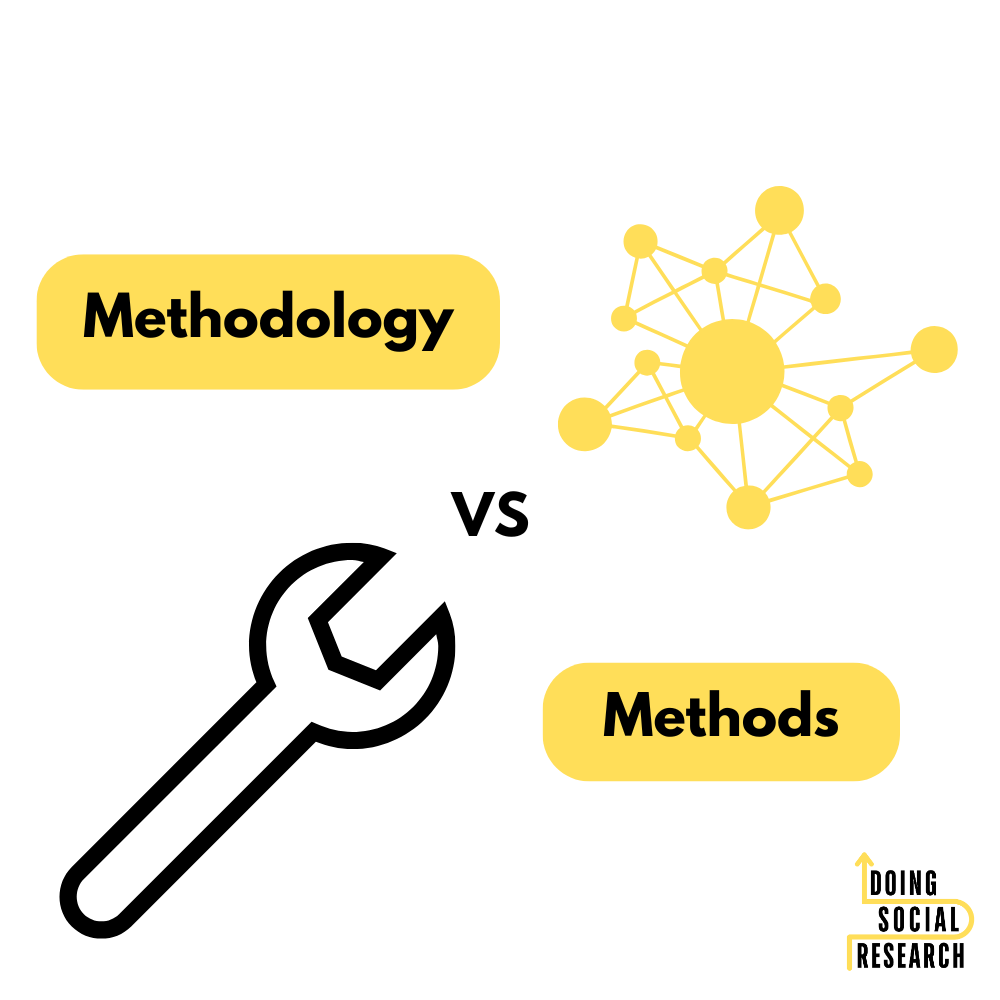
Methodology refers to systems of techniques for how one should or could carry out research. Methods are the specific tools or techniques used to carry out research. These terms are often used synonymously, but they are slightly distinct. Methodology is a broader concept within which many methods fall.

An example of the difference might be to say that I employ quantitative methodologies which might include methods such as descriptive statistics, linear or logistic regression, or structural equation modeling. Alternatively, qualitative methodologies include such methods as discourse analysis, one-on-one interviewing, or ethnography.

Methodology and methods are both guided by epistemology, too. Epistemology is the theoretical exploration of how one can best understand the world. The epistemology known as positivism suggests that there can be universal truths unveiled through scientific research, whereas standpoint theory is a more relative epistemological approach where truth is said to depend on one’s particular social position. Differences in epistemology lead to differences in methodologies and methods. Those who believe in objective truths tend to employ quantitative methods and those who stress relativism are more likely to use qualitative methods; although these are not rigid rules.

Post navigation

Previous: Qualitative vs (?) Quantitative
Next: Sampling Decision Flowchart

Related Posts

Qualitative vs (?) Quantitative

January 19, 2024July 24, 2026 Phyllis L. F. Rippey

What is Science?

July 10, 2019July 24, 2026 Phyllis L. F. Rippey

Qualitative Methodologies

January 13, 2023July 24, 2026 Phyllis L. F. Rippey
Copyright All Rights Reserved | Theme: BlockWP by Candid Themes.
We use cookies to ensure that we give you the best experience on our website. If you continue to use this site we will assume that you are happy with it.