
SHOW NOTES
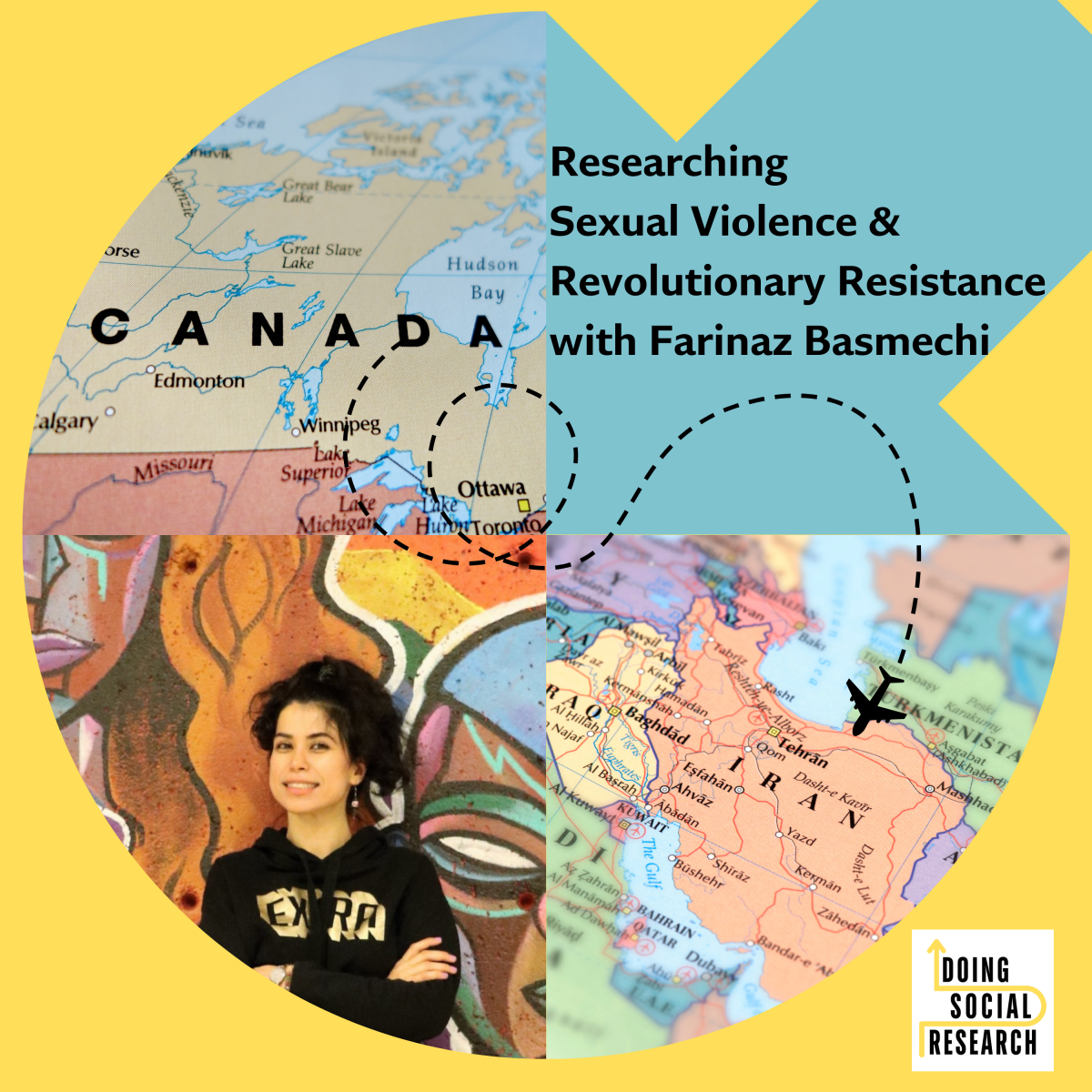
In this episode, feminist sociologist Farinaz Basmachi shares her current doctoral research on sexuality, sexual agency, and sexual violence in Canada and Iran, as well as the research from her first dissertation (yes, she’s doing TWO PhD’s!) titled Not Just About a Piece of Cloth: Three Content Analysis Studies of an Online Anti-Mandatory Hijab Movement in Iran. They dig into the long history that led to the ground breaking 2022 Woman, Life, Freedom uprising against the Iranian morality police. The episode concludes by highlighting the importance of building professional networks, engaging with professors and peers, and suggestions for taking advantage of opportunities for publishing and gaining teaching experience in graduate school.
Guest Bio
Farinaz Basmechi is a PhD candidate in the Feminist and Gender Studies Institute at the University of Ottawa after already completing another PhD in Sociology from the University of North Texas, after getting a Master of Science in Sociology from the University of Alzahra in Tehran, Iran, and a Bachelor’s of Social Sciences Research from the University of Tehran. Her current dissertation explores graduate students’ experiences with their sexuality and sexual violence. She is also a researcher on the Lesbian and Gay Liberation in Canada project and has published in the Canadian Journal of Communication. Farinaz is also an active contributor to university life as a member of the Institute of Feminist and Gender Studies’ Graduate Student Association and as the representative for part-time instructors in the School of Sociological and Anthropological Studies.
Key actors, events, and ideas discussed during the episode
Shah Mohamma Raza Shah Pahlavi
My Stealthy Freedom (#MSF)
White Wednesday
Works Cited
Bala, Suruthi and Hannah Maguire. 2024. “Episode 354 – Mahsa Amini & The Morality Police.” RedHanded. Retrieved December 13, 2024
Basmechi, Farinaz. 2021. “Not Just About a Piece of Cloth: Three Content Analysis of an Online Anti-Mandatory Hijab Movement in Iran.” PhD dissertation, Department of Sociology, University of North Texas.
Basmechi, Farinaz. 2023. “The Iranian #MeToo Movement.” Pp. 267-281 in The Other #MeToos, edited by I. S. Cheema. New York, NY: Oxford University Press.
Basmechi, Farinaz, Donna Barnes, and Morteza Heydari. 2022. “Hashtag Activism: Tactical Maneuvering in an Online Anti-Mandatory Hijab Movement.” Sociological Spectrum 42(1):18–39.
Granovetter, Mark S. 1973. “The Strength of Weak Ties.” American Journal of Sociology 78(6):1360–80.
Rippey, L.F. Phyllis. 2021. Breastfeeding and the Pursuit of Happiness . Montreal, QC: McGill-Queen’s University Press.
Related Content from Doing Social Research
Researching an Ellipsis with Dr. Michael Allan
Farinaz’s post on Doing Social Research: 16 Tips for Succeeding in Graduate School
Get in Touch & Join the Conversation!
Join the Doing Social Research Facebook Group!
Follow us on Instagram @ Doing_Social_Research
email: [email protected]
Errata
The My Stealthy Freedom movement started in 2014 not 2012.
Transcript
00:00:01 Speaker 1
Hello and welcome to the doing Social Research podcast where I talk with some of my favorite people who do Social Research to dig into the cool projects they’re working on.
00:00:10 Speaker 1
My goal is to help demystify research for students.
00:00:13 Speaker 1
Inspire other researchers and provide a platform for all the brilliant work of folks doing research in the humanities and social sciences.
00:00:19 Speaker 1
I’m your host, Phyllis Rippey, a professor of sociology, the University of Ottawa and creator of the website doing Social Research.
00:00:26 Speaker 1
Look, but today, we’re not here to talk about me.
00:00:29 Speaker 1
We are here to talk with the delightful and amazing Farina Basmechi.
00:00:32 Speaker 1
Farinaz is a PhD candidate and feminist and gender studies at the University of Ottawa.
00:00:37 Speaker 1
After already completing another PhD in sociology from the University of North Texas after getting a Master of Science and sociology from the University of Al Zahra in Tehran, Iran and a Bachelors of Social Sciences research from the University of Tehran, her first dissertation was titled not just about a piece of cloth.
00:00:56 Speaker 1
Three content analysis studies of an online anti mandatory hijab movement in Iran.
00:01:01 Speaker 1
And her current dissertation.
00:01:03 Speaker 1
I still can’t get over it.
00:01:04 Speaker 1
Who does 2 dissertations?
00:01:05 Speaker 1
Farinaz.
00:01:07 Speaker 1
Does my friends.
00:01:09 Speaker 1
So her current dissertation explores graduate students experiences with their sexuality and sexual violence.
00:01:14 Speaker 1
She is also a researcher on the Lesbian and Gay Liberation in Canada Project and has published in research in the areas of gender and sexuality, content analysis and digital media.
00:01:23 Speaker 1
She and I have also started to work on a project together analyzing American presidential discourse used to enter into the many wars the US has entered into since the start of the Cold War.
00:01:33 Speaker 1
And we would start doing that if I would ever finish my other projects.
00:01:36 Speaker 1
I need to do so we can really.
00:01:38 Speaker 1
Get into that.
00:01:39 Speaker 1
Farinaz is also an active contributor to university life at both the Institute of Feminist and Gender that is in as a member of the Institute’s Graduate Student Association, and also as the representative for part time instructors in the School of Sociological and Anthropological Studies, where she’s going to be teaching our gender and society course in the winter term.
00:01:58 Speaker 1
Can someone tell me what this woman doesn’t do?
00:02:01 Speaker 1
I know that I say this every episode with every guest, but it’s true.
00:02:05 Speaker 1
I am extremely excited to learn more about what you’re working on and to hear just spend some time with you to hear about what you’re doing and I want to hear about your research and also maybe we’ll talk about some of the challenges you face as an international student.
00:02:19 Speaker 1
Maybe have some advice for other graduate students and how can someone else be as successful as you?
00:02:25 Speaker 1
Anyway, welcome to my podcast.
00:02:28 Speaker 1
Hello.
00:02:28 Speaker 2
Hello.
00:02:29 Speaker 2
Thank you for having me.
00:02:31 Speaker 1
Well, I am just delighted.
00:02:33 Speaker 1
So I like, you know, just cause I’m still.
00:02:37 Speaker 1
I’m still building my brand, which I think is a hilarious thing to say, but anyway, doing Social Research.
00:02:44 Speaker 1
So what Social Research are you doing these days?
00:02:48 Speaker 2
Well, at the moment I my main project is my dissertation and I’m working.
00:02:53 Speaker 2
As you said, I’m working on the experience of graduate students with sexual violence and sexual agency and mainly on university campuses, and more specifically focusing on their experience during college 19 pandemic.
00:03:11 Speaker 1
Ah, interesting.
00:03:12 Speaker 1
So what do you you said, sexual agency.
00:03:14 Speaker 1
What do you mean by that?
00:03:16 Speaker 2
Well, um since um the like I can say the midst of uh having neoliberal era um talking about agency is being one of the main topics.
00:03:32 Speaker 2
But when it comes to sexual agency and there are aspect that I’m more interested in how women in this day and age but neoliberal ideas, it’s kind of putting the responsibility on their shoulder under for the happiness for their sexuality, for the.
But they’re dating for many, many aspects of their lives.
How they, um perceive that and exercise that sort of agency?
How they meet other people, how they protect?
Themselves from loss of dangers.
How they manage their relationships, how they, hmm.
Find people like minded people or when they encounter sexual violence, how they deal with that.
You’re interviewing students at the are we allowed to say at the University of Ottawa?
Yep, because of the license of the the topic survey or like quantitative, UM, I didn’t find it as, um, compelling or like, I don’t know, like I ended up.
And what was and the University of Ottawa?
So, comparing Canada to Iran, I see, OK.
of people in general and specifically woman’s sexual activity and bodies, whereas in in Canada and People University of Ottawa, they don’t have necessarily those kind of regulations, but there are some regulations to protect them.
From quote unquote, sexual violence.
And it’s interesting how kind of more or less.
This despite the, the very two different context that I’m looking at the the the themes as teamed up.
Yeah, it is very interesting and kind of mind blowing.
And patriarchal rules try to kind of have control over them.
And then like, what is kind of the same about them, maybe I just ask you 5 questions at once I’m.
1st a focus on what uh, what is being a woman in Iran?
Well, the, the, the woman’s movement in Iran has a very long history, like 100 years.
For last 100 years and it’s been, um, kind of a battleground, their bodies, their.
Actions and public **** showing private spheres.
Battleground of um, politics and politicians, and also some traditional patriarchal rules.
And right now they can go to school.
And there were different movements trying to take back some rights in, like, a family and.
But of course, there are people living their lives, but secretly.
Think about two years ago and 20.
It’s can I can I know it for one second.
Summarize what I think happened, and then you can tell me is this correct or not?
But that so Iran has a pretty interesting history in terms of having.
Sort of like very long sort of Persian dynasty.
Like element to it, where there was like the Shah, was like a royal, right?
And so there was like a lot of um, like he was very interested in.
Sort of like Western culture, and like all kinds of stuff.
Um to sort of traditional Muslim ideas because it’s my understanding.
Tell me I’m wrong cause I’m I’m yeah.
It was kind of like enforcing on People’s Daily lives were not really.
But because we want to follow the West.
That is, though, that is like the true feminist ideal.
It sort of laid the foundation and then thy Atallah sort of sort of came in, sort of.
It was like a moment where then he could grasp this power, but that what was.
It’s that there was this sort of growing movement.
Um, that he was able to take advantage of when there was this major.
Um, sort of like economic situation is that is that am I getting?
We could, you know, I don’t know.
And Iran located very close to the other times suit union.
It’s there are lots of younger generation.
We’re kind of leftist because of the actions of Shah.
Of course, it was kind of pushing them away from the imperialist perspective.
Who was kind of like lots like a cleric.
So basically there were two main like pillars of power pushing their evolution.
And so and it was, you know, in opposition to the.
I the the oil got became kind of a national property of Iran because it used to be like that.
And who was I at a time trying to and won the battle and won their court and he?
Got the um oil fry all uh benefits for Iranians, but in the there was a coup.
No, but to me this is all real.
Islam about Iran, about like feminism in Iran like there’s all of these.
Well, maybe not everyone in Iran makes assumptions.
It’s more complex than just that.
I mean, everywhere is more complex.
Like what you said at the start to go back to that is that women have been fighting.
Like for their liberation, for their freedom, for um.
And so, um, that’s the too long didn’t listen to Phyllis stumbling through version.
So a couple years ago there was, like, feminist movement was sparked again.
So go back to what you were trying to say.
Before I interrupted you 20 minutes ago.
There are some positive aspects to um.
It was not really accepted because they were like they’re associating those setting with.
But there was, like, couldn’t go Islamic revolution made, and a cultural revolution.
That’s that happened right after the revolution made.
The textbooks that try to make them more Islam.
So they were like, so they got rid of, they got rid of all the fun.
I was not really a part of that stuff, but anyway.
Yeah, the woman got, like, the the number.
Like at some point on the number of woman in in universities exceeded the the number of men.
So like and I think that’s the sill the case.
And woman and those are kind of positive outcome.
Unintentional, probably, but right.
That’s and that’s the demand of people.
But and and and and another movement has started.
And then movements name was myself.
The students, female students in schools to.
I I cannot remember what was the title but the like person producing with their teachers as well.
So basically, um, that was a very big.
Because woman was were trying to resist the mandatory job laws.
Then, since 2005 or a bit later, the government started.
Kind of an institution with name Morales.
OK, so in 2005, the morality police.
So and and they were basically standing in the street.
If something like finding someone who was not really having a proper her job, the.
This is just like everyday women who are just.
And it was like, but they’re trying.
To do what they’re supposed to do.
They just like we’re sloppy or I don’t wanna even say say that like it was just like, whatever.
And there were some encounters.
So you can find your way to not really.
That’s like it’s like Google Maps.
Now when I’m driving, it’ll be like there’s a police officer here.
So there there be like, there’s the morality police avoid this quote, right?
Uh woman got arrested by morality police and that person named Masai mini got uh like died in while.
Uh under the arrest of morality.
Fun fundamental values of Islamic Republic as a government.
Well, so was she killed by the morality police?
Acknowledge that it was anything like the encounter between police and that person.
Footprint that is like Romain and everyone watched it, is where, um, massage.
You know, was in the morality police station and that like, she just falling.
And then then after two days or three days, she died in a hospital.
And so, um, but but like, because of all the brutality of police towards women while policing her.
So it right or responsibility too?
Yeah, not not let their people die.
And um, so um and I haven’t traveled to Iran since.
I know that’s um, it’s um, not really like.
Like I can say that like it happened like last two years, it happen.
It doesn’t really like you shouldn’t really play.
They were like, we’re like mocking leaders like that like it.
It was like an explosion across the country of women. Just.
Like basically being like hell.
No, we’re done with you like knocking off.
Yeah, and it was not only women.
And that was the beauty of all these move and it was not necessarily woman protesting this.
But um woman life, I would like to call it normal life.
Liberty, then freedom because of.
Like the uh meaning of liberty, I I find it more positive than freedom.
Well, in general, when when do you think of freedom?
It’s in my head and I I think it would become somehow true that you’re thinking of freedom from.
It is kind of looking backward.
You don’t want something, but it’s not really a striving for something.
00:38:11 Speaker 1
I love that it’s like liberation, liberty.
So let’s go back to your research.
Know about and it was like so embarrassing to me.
We’re going to miss really important explanations that anyway, so that’s all to say.
Like, I’m so glad we went down that road of context.
I still can’t believe you’re doing 2 dissertations anyway.
But so a lot of that was sort of context was there.
Um, but and now you’re looking at sexuality?
And so the point that you were making before at the start is that you’re sort of noticed.
That’s that’s a thing and win.
I know that you haven’t finished like collect.
Have you’re still collecting data, or you’re still analyzing data?
Well, yeah, I I finished collecting data.
I finished all the interviews, but I need to start analyzing them and I’m on that point.
But like when I was collecting the interviews, when I was interviewing different woman.
So there is imagine there is non but in the context of Canada there is a lot of policies.
But interestingly, women in both settings have experienced sexual violence.
Despite like, let’s say in Iran, if you are not really quote unquote.
It’s not allowed for you to have sexual intercourse.
I mean, it’s like in a certain sense, it’s like, oh, yeah, obviously.
In a way that wasn’t set up to benefit them necessarily, you know.
Uh, like a comprehensive sex education course?
For everyone who is living in Canada, we cannot really expect them to.
Just you need to know there’s a policy you haven’t read it like, of course.
To teach people to change a behavior.
We cannot really assume that because we stopped like we passed log.
It’s gonna happen by just like a billing.
And I think it’s also interesting, again, this idea of like you know.
And it’s, you know, like how can women stand in?
It’s like, but women are being policed via violence all the time in Canada.
Um to help them learn how they need to be more careful when they go out like it’s disgusting.
That is, even sometimes in this like.
Backwards, like I’m gonna help you.
Like altruistic violence or something weird, you know?
It’s just like, OK, so we have the basic rights here.
We have the policy, but no, it’s not necessarily being exercised in Our daily lives.
Yeah, yeah, this is also fascinating.
But I also have some questions I want to ask you about.
Just like being a graduate student, getting into this research and why?
It’s just like, yeah, that’s a question that I encounter alone.
A route that sound like people usually go but.
1st I been always interested in, um, like a studying gender and sexuality.
That was one, and then a second.
And to be able to do that, I know my fellow.
Professors at the University of Tehran.
There’s no like gender studies department or something.
Well, there is a women’s studies, but I’m not really like in close relationship.
I know that like studying sexuality few years ago when I was about to start the program here.
Um, the one of the professors there.
Um, who was the head of sociology department at a time, was like asking me questions.
OK, we need people like you come by to do teach.
And he said remove it from your.
They don’t talk to other people.
Oht, like just from your CV, even just like using the word sexuality.
Just so you know, and I still want to come back and.
It’s so true, though, that it’s like, you know, I another.
Tyler Escott, who’s getting his PhD at the Institute now as well.
Like he’s looking at sex and but, like, *********** and sex work.
And like he was just saying how no one will talk about sex.
And and I also know from a number of years ago there’s a woman.
I’m forgetting tiffert leonore tieffer.
Like and it’s so bizarre because it’s.
And yet, you know, everyone has an economics department.
But like where people not talking about sex, you know, no offence.
Economics, but it just it just.
That’s, um that you wanted that.
And so like, what do you find?
Especially because I was, you know, department chair, the institute last year.
That from feminist and gender studies that you don’t give from sociology or vice versa.
Well, from what I understood and I learned so far that there’s a difference in mythology.
Ethology coming from sociology, background.
Kind of find myself um the closest.
In in, um, sociological approach.
So when we need those two actually kind of, um, um.
Aspects to knowledge and the the way to see social sciences in general, to kind of.
Develop and promote humans condition even while having the kind of basis for life.
Moments where I’m like, uh, I wish I was just always that the institute, because I just.
So I mean, I love all the props there.
And you know, it’s just like felt very much at home.
But then there also are moments where I’m like, I’m a sociologist.
So I I have that sort of background, but I still am like I need evidence I need like I need.
We need to take your opinion out of it.
Really kicks your *** and grad school.
There’s something wrong, and then there’s other times I’m like but.
Have to do is but then anyway.
And what about what about like advice?
Because you’re an international student.
Especially as international students, what are like, what’s that?
I mean, aside from having ridiculously high tuition, that is like, I don’t know how you will pay it.
Behave public schools and universities.
We need to have it like national test and after that like the ones who do better.
They can get into those public schools, which are.
I know it’s revolutionary, but like, that’s my mindset.
I should have pay, so I don’t know.
An international student, it’s not really easy here.
Uh, because, um, the opportunities are very limited.
Very, very limited, but um, maybe it’s not necessarily the the thing that I want to say.
It’s just you’re working on your own room.
Unordered dictation you have to work on that anyway.
Search in somebody elses work.
But yeah, if there is opportunities for you, just try to do it.
Maybe my topic is not really interested.
And the thing that I learned and it worked super like well in my favor.
More about the campuses atmosphere and also like learning more about the topic that I’m working on.
Maybe it’s not the case for you.
If you were like mechanical engineer, I don’t know.
Ohl and despite you were super busy, you were really kind to attend those meetings and answering.
I love helping graduate student.
This is why I’m doing this podcast in my website.
It’s like I love, like helping people who because both of my parents were proofs.
So it’s like I always had my parents where I could ask them and it’s like.
But the things that I know that like I got to know everybody doesn’t get to have that.
But for a lot of people, it’s like this is even.
But even then, it’s a totally different system here than it is.
Um to people just starting out.
Like and also I’m working with like last year.
Like Terry, who’s um working with.
Yeah, he’s in the Deans office in the Grad studies office.
And yeah, in those meeting, I got to meet.
Ah, another professor from sociology.
Present yourself and you you won’t be active.
After graduation, you want to get a job, so you need to be cautious of that.
You need to have like publications.
That’s another thing that you need to be make sure that like you have something even small.
But it’s and there are professors that are hard to get ahold of.
And like we chatted about stuff, but I was interested in your research.
And then it was like you just came back again.
So I’m like, hey, department chair and sociology.
She’s like a pal of mine if you, you know, fairness is great.
Wanna put in the good like just putting the good word?
And he was like, oh, good to know.
Cause he didn’t know who you were because you’re in a different department like.
And so it’s it’s just, it’s like weird how things like that.
Granovetter weak ties 1972 comprehensive exams will never will never die. But.
That’s what they’re supposed to do anyway.
So with the strength of weak ties, you want to build those weak ties.
As sociologists talk about, because that’s where you find out the opportunities.
And so it doesn’t have to be anything like major.
Because I get, I get so excited.
I’m like, let’s do this project and that project.
So it’s like you want to have like a few different things in the fire, so.
I think you know it like at least for me, I felt really scared.
If people critique them, they’ll little mean that I’m less of a person.
You know, so I think that that’s.
I could do that, which I also think is great.
Wrote an entry for doing Social Research.
Is there anything else that you wanna add before?
So one more thing that I recently learned that is kind of might be helpful and if you are.
And then in case of acceptance, you can start writing.
No, I think that’s really good advice.
I hadn’t really thought about it.
I think I often I’m like oh, wow, that’s like so cool.
I was working on this thing and this call for papers applies, but you’re I’m doing it backwards.
That’s like feminist and gender studies keeps changing its name.
But whatever is the latest name right now for them, but or what?
You know, whatever you’re like political science.
Call for proposals there or like university affairs, might also in Canada.
And so they only do like 1 issue a year.
And that he has an editor will have to think.
You know, sometimes there could be a paper.
Whereas if you have a call for papers, it’s like you know that this is what they want.
And so, because sometimes also we can like waiting.
Acted like so there’s there’s a like there’s a there’s a kind of clock.
So it’s if you have, there’s a little bit more as you said.
So no, I think that’s a really, really good advice.
Well, because the process of getting publications out, it’s kind of liked long, long and.
So it’s it’s good to kind of having some shortcut.
That’s and another thing that I was thinking.
And there is like a kind of collective agreement, even though not written, that like we are.
Like divorce, that can happen is just like nothing happened.
Most people are kind of like they they definitely willing to help you.
For, you know, all kinds of things.
And it’s like, well, no, this is like, this is how professions work.
And there was, oh, and another trick that I think I don’t know if it only works for me.
And so I’m getting more where people are city.
Yeah, I’ll talk to you if you read my book.
Breastfeeding in the pursuit of happiness or whatever.
And then I’m going to take the time to at least reply and.
Say I’m sorry, I can’t help you.
I just had a chat with someone this week who was a potential new student, a potential new student.
Anyways, is there anything else you wanna add before before we say farewell?
You can and it’s possible for you based on your like if if you want to specifically say NI.
To me, yeah, just hope for best.
Yeah, and have some fun while you’re doing it.
I also believe in doing it, but that’s harder.
Um, I mean, you’re always just so generous with your time and your and your thoughts.
Thank you for having me and um, I am looking forward to having you again on our lunch.
I’ll come to more lunch and learns I love it.
Well, thank you for listening to the.
Doing Social Research podcast.
I’d also love to connect with you.
Or you could join the doing Social Research Facebook group for some really exciting conversations.
I think we are now up to four followers.
We want to keep the conversation going.
I’ll put links to my social media and the references mentioned to date in the show nodes.
Unless it’s to tell me that I say like too much, or I do this sound like.
You know, it’s so annoying and you’re never going to unhear it anyway.
Don’t forget to check out the website doing social.
Special thanks to our sound editor Willow Rippy Young for making a sound amazing.
Jonathan Boyle wrote our theme music and I’m Phyllis Rippee.
This is the doing Social Research podcast.
Don’t let the ******** get you down and keep doing Social Research.